Papers
Important Documents Organization: What to Keep and What to Shred
Every household has a drawer, a box or a shelf where paper goes to wait. The real question is never "am I organized." It is "can I get rid of this, and will I regret it?"
This post answers it. What to keep forever, what to keep for a year or a few years, what belongs in the shredder, and where the originals should live. The retention periods below come from the IRS and the Federal Trade Commission, and each says which.
One note before the piles. This is an organizing guide, not tax or legal advice, and the rules below are the general federal ones. Your state, your lender, your insurer or your attorney may want something kept longer, so ask before you shred anything you are unsure about.
Sort into four piles, not twenty
Most paper-sorting advice fails because it asks you to build a filing system first. You need four piles on a table instead:
- Keep forever. Papers that prove who you are, what you own and what was legally decided.
- Keep while you own the thing. The house, the car, the appliance, the policy.
- Keep for a set number of years. Almost all of this is tax paperwork.
- Shred. Anything with your name, account number, Social Security number or signature that is past its date.
Anything that fits none of those four is usually recycling. Sort first, file second: if you stop to build folders halfway through, the sorting never finishes.
Pile 1: keep forever, and lock up
The FTC's consumer advice on which documents to keep and which to shred puts these in a "keep forever (and lock up)" group:
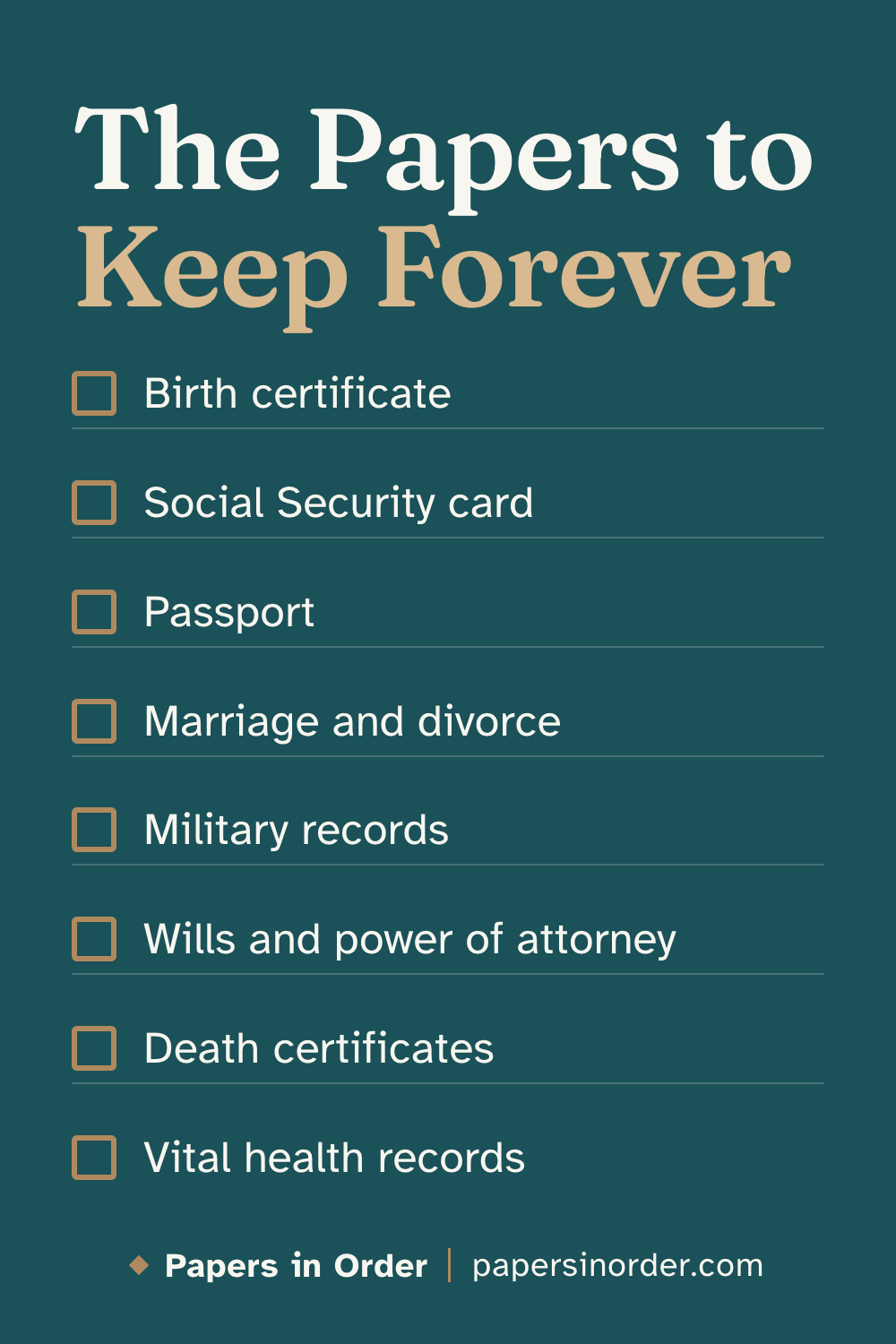
- Birth certificates and adoption papers
- Social Security cards
- Valid passports, and citizenship or residency papers
- Marriage licenses and divorce decrees
- Military records
- Wills, living wills, powers of attorney, and retirement and pension plans
- Death certificates of family members
- Vital health records
Two things worth adding.
Keep expired passports too. The FTC says to shred expired credit cards, driver's licenses and other forms of identification — but a passport is different. The State Department's instructions for Form DS-11, the passport application, accept a "Fully valid, undamaged U.S. passport (may be expired)" as primary evidence of U.S. citizenship. An old passport can save you a trip to a vital records office, so keep it with the current one.
Keep copies of your filed tax returns. The IRS says plainly: "Keep copies of your filed tax returns. They help in preparing future tax returns and making computations if you file an amended return." It sets no end date for the returns themselves. Many people keep them for good, and keep the supporting paperwork on the shorter schedules below.
Pile 2: keep while you own it
These stay in the file as long as the thing they describe is yours. The FTC groups them as "keep while you own":
- The title to your vehicle
- The title or deed to your home
- Documents related to mortgage or vehicle loans
- Home improvement receipts
- Rental agreements and leases
- Sales receipts and warranty information for major appliances
Home paperwork has a tail after the sale. IRS Publication 523, on selling your home, says to keep the records that document the property's adjusted basis — the purchase, the closing, the improvements: "In general, keep these records until 3 years after the due date for your tax return for the year in which you sold your home."
Insurance policies work the same way in practice: keep the current ones, and keep an old policy until any claim on it is settled. That last part is common practice rather than an agency rule.
Pile 3: keep for a set number of years
This is where most of the worry lives, and it is almost entirely tax paperwork. Here is what the IRS says about how long to keep records, on its "How long should I keep records?" page:
| Situation | How long |
|---|---|
| The ordinary case | 3 years from the date you filed the return — or from the due date, if you filed early, since the IRS treats a return filed early as filed on the due date |
| You file a claim for credit or refund after filing your return | 3 years from filing, or 2 years from the date you paid the tax, whichever is later |
| You file a claim for a loss from worthless securities or a bad debt deduction | 7 years |
| You did not report income you should have, and it is more than 25% of the gross income shown on your return | 6 years |
| You did not file a return, or filed a fraudulent one | Indefinitely |
| Employment tax records | At least 4 years after the tax becomes due or is paid, whichever is later |
The employment tax line matters here more than people expect. If you pay someone directly to help with a parent, you may be a household employer — whether you are depends on rules the IRS sets out in Publication 926, its Household Employer's Tax Guide. That guide gives the same clock: "Keep your employment tax records for at least 4 years after the due date of the return on which you report the taxes or the date the taxes were paid, whichever is later."
One more specific worth knowing. W-2s outlast the 3-year rule. The note printed on Form W-2 says to keep Copy C for at least 3 years after the due date for filing your return, but adds: "to help protect your social security benefits, keep Copy C until you begin receiving social security benefits, just in case there is a question about your work record and/or earnings in a particular year."
Pile 4: keep for a year
The FTC's one-year group is short and covers most of what clogs a drawer:
- Bank statements
- Pay stubs
- Undisputed medical bills
- Credit card and utility bills
- Deposited checks
Two habits make this pile safe to empty. Check each pay stub against your W-2 before it goes, and hold anything longer if it supports a tax item, a loan or an unsettled dispute. A statement that documents a deduction is tax paperwork now, and follows the schedule above.
What to shred, and how
Part of the FTC's shred list:
- ATM receipts
- Offers of credit or insurance
- Credit reports
- Prescription information for medicines you no longer take
- Expired warranties
- Expired credit cards, driver's licenses and other forms of identification
Remember the passport exception above, and check receipts against your statement before they go rather than shredding them the same day.
On method, the FTC's advice is short: "When it's time to dispose of documents with your personal or financial information, shred them. If you don't have a shredder, look for a local shred day in your community." If this sort filled three grocery bags, a community shred day is one way through it. Your town, county or library website usually lists the next one.
Where the originals should live
Sorting is half of it. The other half is deciding where the survivors go, and writing that down.
Keep-forever papers go somewhere fireproof and locked. A fireproof box, a safe or a safe deposit box all work. Pick one and use it for everything in pile 1, so there is one answer instead of six.
Keep-while-you-own and tax paperwork can live in an ordinary file. A drawer or a labeled box is fine; these get pulled out often, so convenience matters more than security.
The binder holds the map, not the papers. This is the part people skip. Write one line per document: what it is, whose it is, where the original is kept, and whether a copy exists. That page is what turns a locked box into something your family can actually use. Our guide to what to put in a home management binder covers where that page sits among the other sections.
A note on the safe deposit box: excellent for deeds and certificates, slow for anything a family may need in a hurry, since access depends on who is named on the box and on your bank's rules. Keep a copy at home of anything you would hate to wait for.
If an original is already missing
Finding a gap during the sort is normal. Nearly everything can be replaced, and USAGov keeps one page listing who to contact:
- Birth certificate — the vital records office of the state or territory where the birth happened
- Social Security card — the Social Security Administration, online, by mail or in person
- Driver's license or state ID — your state motor vehicle agency
- U.S. passport — report a lost or stolen passport to the State Department, then apply for a replacement in person
- Medicare card — your online Medicare account, or 1-800-MEDICARE (1-800-633-4227, TTY 1-877-486-2048)
The page is at usa.gov/replace-vital-documents, last updated November 17, 2025. Many of these ask you to show another official document to prove your identity or citizenship, which is one more reason the keep-forever box matters.
The afternoon version
If you want this done rather than planned:
- Put the four piles on a table and set a timer for 90 minutes.
- Sort without filing. One paper, one decision, next paper.
- Bag the shred pile and check when your area's next shred day is.
- Put pile 1 in the fireproof box or the safe, all of it in one place.
- Write each pile-1 document on a document inventory page, with where the original now lives, and date that page.
- File piles 2 and 3 by year, not by type. "2025 taxes" is a folder anyone can find.
You do not have to finish. Half the box sorted, with one honest inventory page, beats a plan for a perfect filing system.
The free pages that hold this
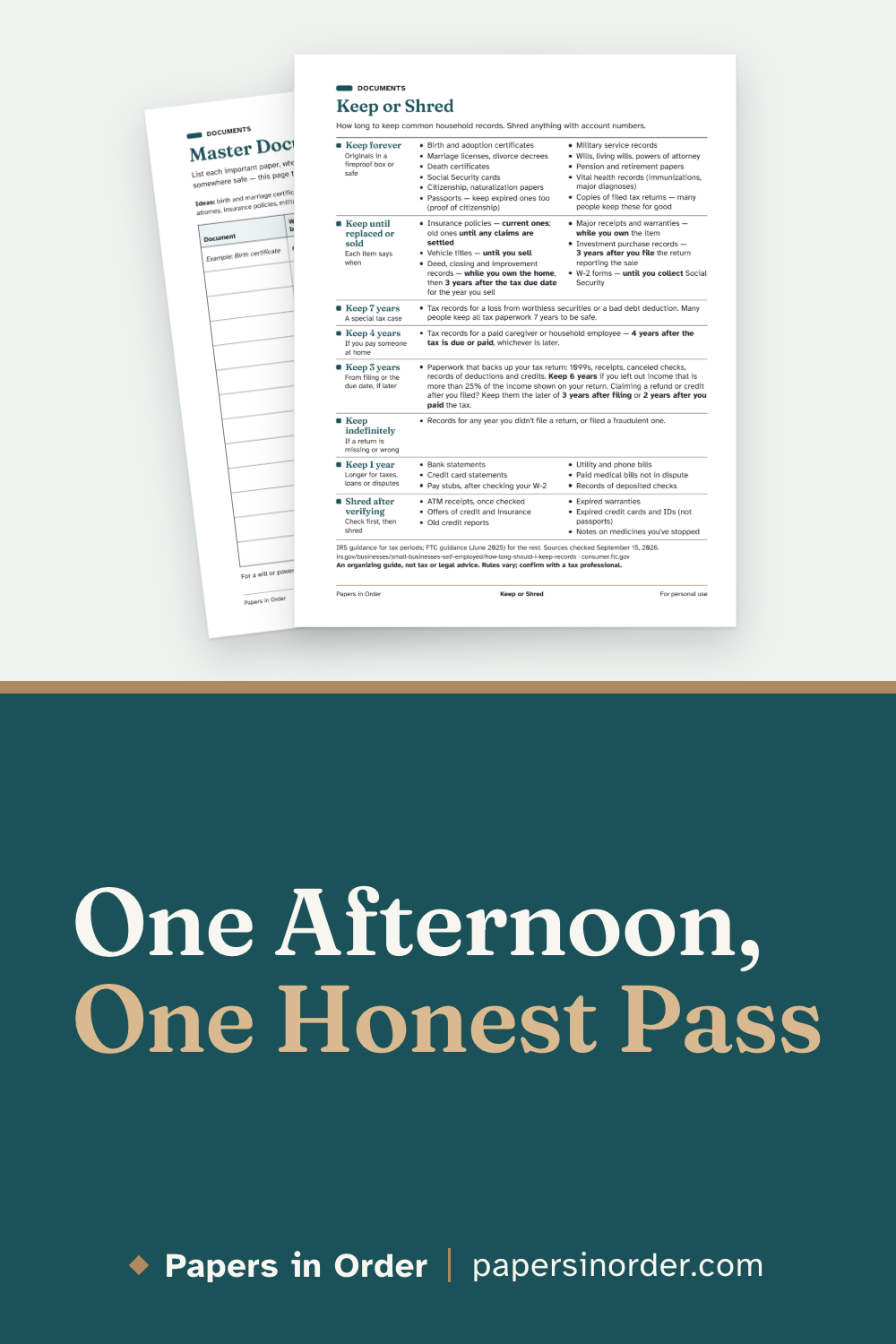
Our free Home Binder Starter includes a Keep or Shred page with these retention periods on one sheet, so you are not looking them up mid-sort, and a Master Document Inventory for recording where each original ended up. Ten pages, US Letter, made to fill in with a pen.
If you are doing this sort so that your family would not have to, our guide to an 'everything my family needs to know' binder covers the seven things they will look for first.
Sources: the IRS page "How long should I keep records?", IRS Publication 523 (Selling Your Home), IRS Publication 926 (Household Employer's Tax Guide) and the note printed on Form W-2, all at irs.gov; the FTC consumer alert "Protecting your personal information: Which documents to keep and which to shred" (June 2025) at consumer.ftc.gov; the U.S. Department of State's Form DS-11 instructions; and USAGov's page on replacing lost or stolen ID cards at usa.gov. Checked September 2026. An organizing guide, not tax or legal advice.