Papers
What to Put in a Home Management Binder: The 6 Sections That Cover Everything
A home management binder is one binder that holds the information your household runs on. Where the important papers are. Which medications someone takes. Which bills go out each month. Who to call when the water heater leaks. It sounds like a lot, but it fits into six sections. This guide covers what to put in each one, what to keep out, and how to set it up in one evening.
What a home management binder is, in plain words
It is a 3-ring binder with tab dividers and a few pages you fill in by hand. It does not replace your filing cabinet, your bank's website or your doctor's records. It points to them.
Think of it as a map. The real documents stay where they are safe. The binder says where they are and gives the key details at a glance.
Who needs one? Almost any household, but it matters most when:
- More than one person handles the bills, the house or someone's care
- You are helping an aging parent and keep getting asked the same questions
- You travel, work long shifts or live alone, and someone else may need to step in
- You have ever spent an afternoon looking for one piece of paper
The test is simple. If you were out of reach for a week, could someone else in your family pay the bills, call the right doctor and find the insurance policy? If the answer is "not really," a home binder is how you fix that.
The six sections that cover everything
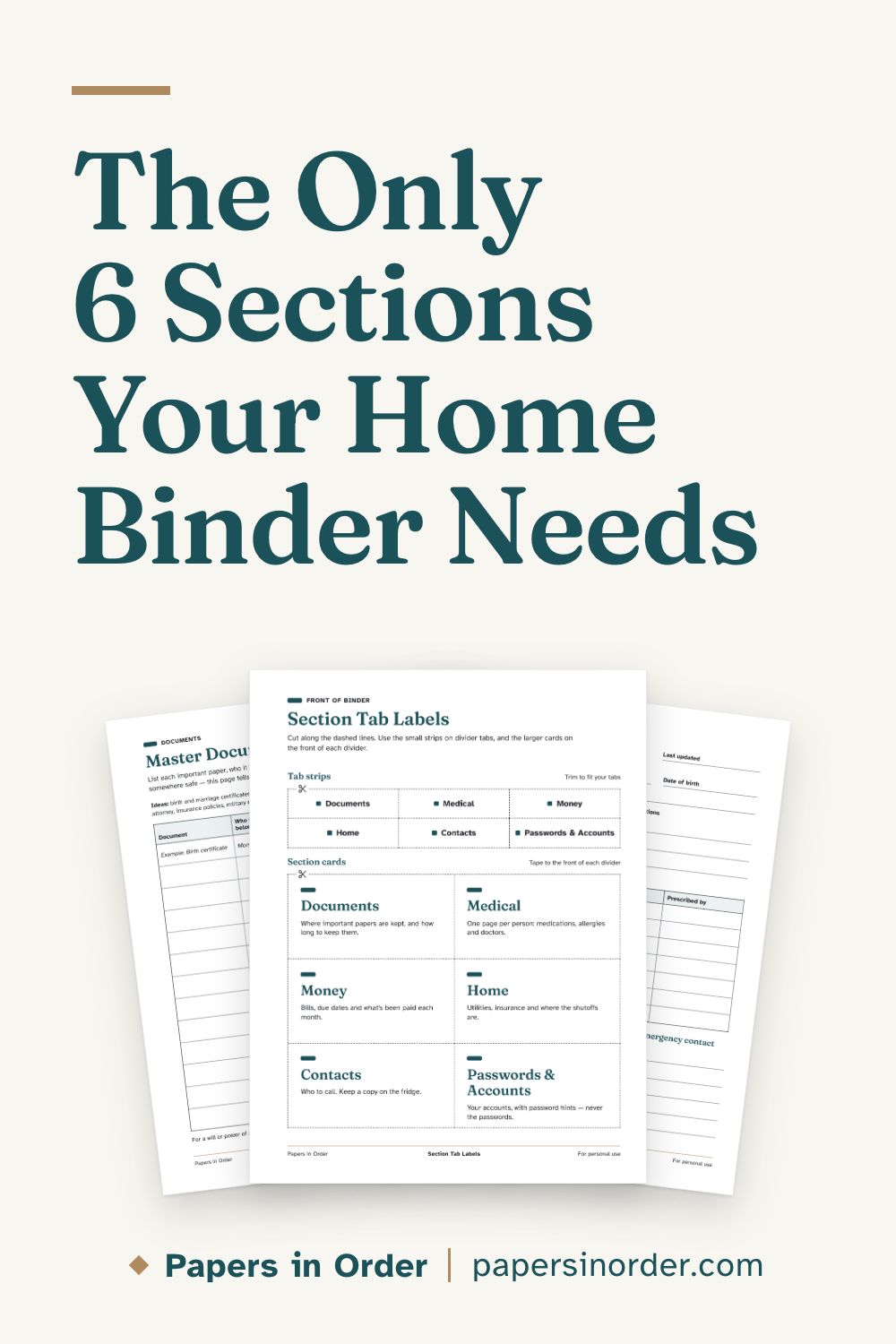
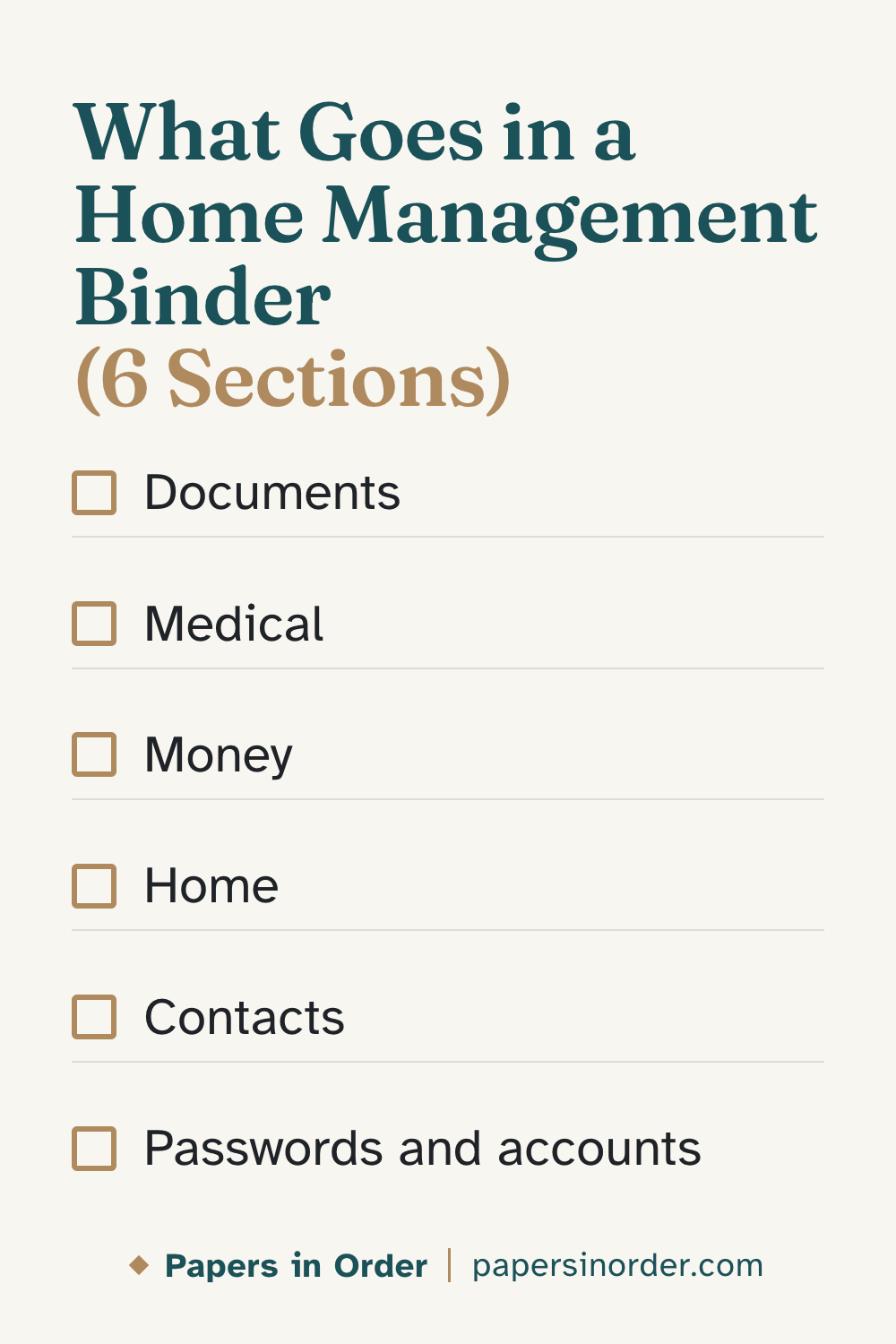
Most binders go wrong by having too many tabs. Six is enough for nearly every household. Here is what goes in each one and why.
1. Documents
This section answers one question: where are the important papers?
What goes in it:
- A document inventory. One line per document: what it is, who it belongs to, where the original is kept, and whether a copy exists.
- A keep-or-shred list, so you know what you can throw away.
Typical entries are birth and marriage certificates, Social Security cards, passports, deeds, vehicle titles, insurance policies, military records and pension papers. You are not filing these papers in the binder. You are writing down where they live.
If you have a will or a power of attorney, list where the original is kept. An attorney can prepare them for your state. The binder only tracks their location.
2. Medical
One page per person. This is the page someone grabs on the way to urgent care.
What goes on it:
- Full name, date of birth, blood type if known, and preferred hospital
- Allergies and reactions
- Medical conditions
- Current medications, with dose, timing and who prescribed each one
- Doctors, with specialty and phone number
- Insurance company, member ID, and Medicare or Medicaid number if there is one
Write medications in pencil, since they change. Put a "last updated" date at the top. An old list can cause as much confusion as no list.
3. Money
This is where the monthly bills live, not the bank statements.
What goes in it:
- A monthly bills tracker. Each bill once: who you pay, the due date, the amount, whether it is on autopay, and whether it has been paid.
- A short note on which account each bill comes out of.
The point is to let someone else keep the lights on without guessing. If a bill is on autopay from a checking account, write that down. It is the kind of detail that only lives in one person's head.
4. Home
This section is about the house itself.
What goes in it:
- Home address, who has a spare key, and the landlord or HOA contact
- Utilities: electric, gas or heating oil, water and sewer, trash, internet and phone, with account numbers and phone numbers
- Insurance: home or renters, auto, health and life, with company and policy number
- Where the water main, gas shutoff and breaker panel are
The shutoffs are the part people skip and later wish they hadn't. Walk the house once and write them down.
5. Contacts
One page, and a copy on the refrigerator.
What goes on it:
- 911 and Poison Control (1-800-222-1222, free and open 24/7)
- Your address and nearest cross street, so anyone calling for help can read it off
- Doctors, pharmacy, neighbors, family, work, school, insurance and the veterinarian
This is the page to fill in first. It is the one you would need fastest, and it is quick to finish.
6. Passwords and accounts
This section lists your accounts so someone can find them. It should not hold your actual passwords.
What goes in it:
- Account or website name
- Username or email
- A password hint that only you would understand
- The recovery phone or email
- Notes, such as "autopay for electric bill"
A password manager is safer still. If you use one, list your accounts here and write down where the manager's recovery details are kept.
What not to put in the binder
A binder is easy to grab, which is the point. It also means it can be lost, picked up by a guest or damaged. Keep these things out.
Original documents. Birth certificates, passports, Social Security cards, deeds and titles belong in a fireproof box, a safe or another secure place. The binder says where they are. A photocopy can go in a sheet protector if that is useful to you, but the original stays put.
Your actual passwords. Write hints, not passwords. A page with every login written out in full is a risk you do not need.
Legal forms. The binder is not the place for a will, power of attorney or medical directive, and our printable pages are not legal forms. Rules differ by state. An attorney can prepare a will or power of attorney. For a medical directive, ask your doctor, hospital or state health department which form is valid where you live. Your binder records that these documents exist and where the signed originals are.
Every statement you have ever received. The binder is not a filing cabinet. Old bank statements and bills go in a file or get shredded on schedule. As a general guide, the FTC suggests keeping bank statements, credit card statements, pay stubs and utility bills for about a year. Keep them longer if you need them for taxes, a loan or a dispute. The IRS generally says to keep supporting tax paperwork for 3 years after you file, with longer periods in some cases. This is an organizing guide, not tax or legal advice. Rules vary, so confirm anything important with a tax professional.
Why this is not a 400-page planner
Search for home binders and you will find huge printable bundles. Meal planners, cleaning schedules, chore charts, garden logs, holiday budgets, reading trackers. Hundreds of pages.
Many of those binders end up half full on a shelf. Not because the pages are bad, but because nobody keeps up 40 trackers at once. When a binder is mostly blank, nobody trusts the parts that are filled in.
A home management binder does one job well. It holds the information someone else would need to run your household for a week. That is why six sections are enough:
- Keep only what you will update. If you would not touch a page in the next year, leave it out.
- Favor one page over five. One medical page per person beats a full medical log nobody keeps.
- Add pages when you need them, not before. If you start caring for a parent, add pages then. You do not need them on day one.
A thin binder that is correct is worth more than a thick one that is out of date.
How to set it up in one evening
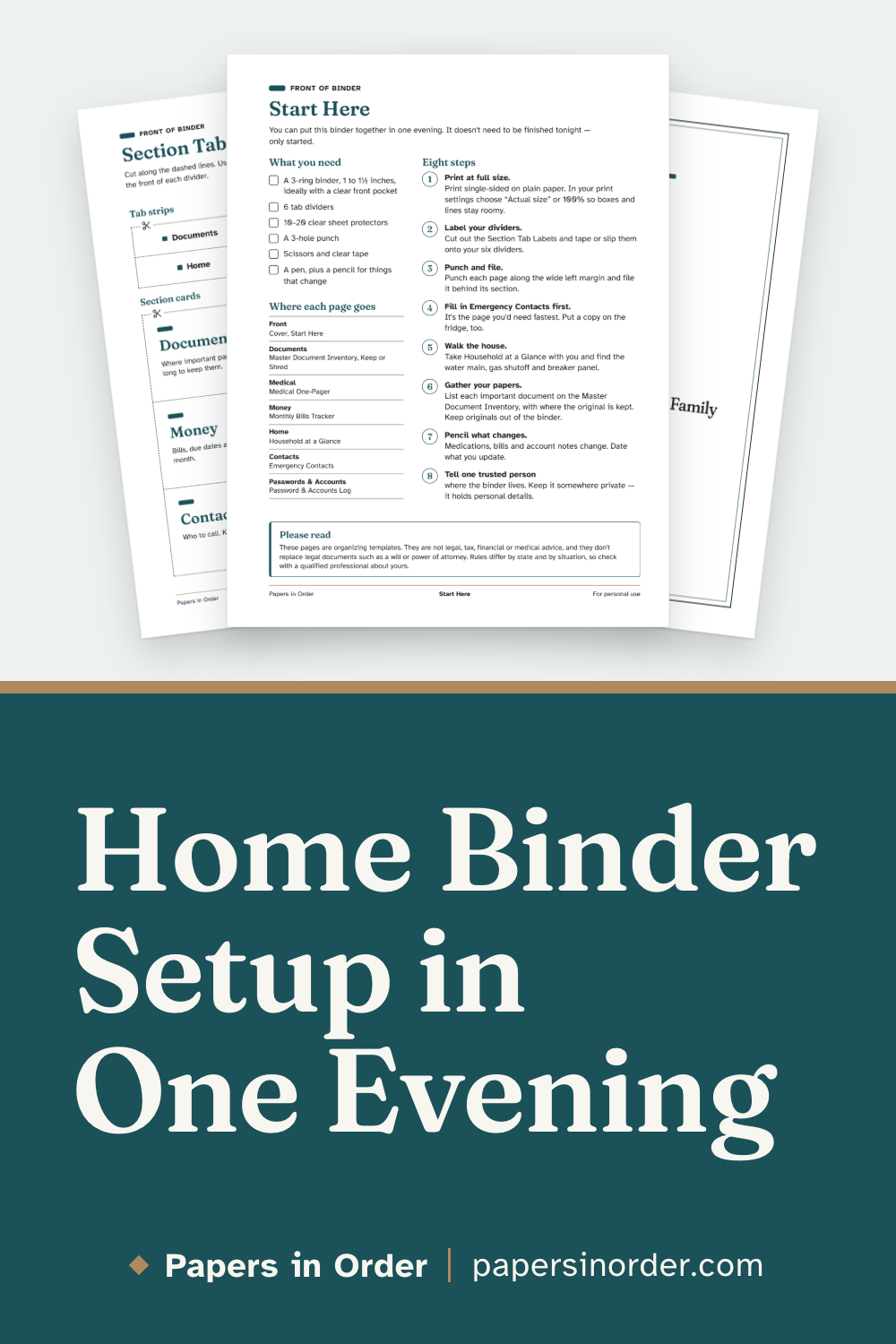
You do not need to finish it tonight. You only need to start it. Here is the order that works.
What you need:
- A 3-ring binder, 1 to 1½ inches, ideally with a clear front pocket
- 6 tab dividers
- 10 to 20 clear sheet protectors
- A 3-hole punch
- Scissors and clear tape
- A pen, plus a pencil for things that change
The steps:
- Print your pages at actual size (100%), one-sided, on plain paper.
- Label the six dividers: Documents, Medical, Money, Home, Contacts, Passwords and Accounts.
- Punch the pages and file each one behind its tab.
- Fill in Emergency Contacts first, and put a copy on the fridge.
- Walk the house with the Home page and find the water main, gas shutoff and breaker panel.
- Gather your important papers and list each one on the document inventory, with where the original is kept.
- Use pencil for anything that changes, like medications and bills, and date your updates.
- Tell one trusted person where the binder lives. Keep it somewhere private.
That is a real binder. Everything after this is small updates.
If you would rather not design the pages yourself, we made them. Our free Home Binder Starter has ten printable pages built around these six sections: a cover, a Start Here page, cut-out tab labels, a document inventory, a keep-or-shred list, emergency contacts, a household page, a medical one-pager, a monthly bills tracker and a Password & Accounts Log. For a page-by-page look before you download, read our guide to home management binder free printables.
Start with the free pages
A home management binder is six tabs and a handful of pages. It works because it is small enough to keep current. Documents tell your family where the papers are. Medical and Contacts get used in a hurry. Money and Home keep the house running. The account log helps someone find what they need without handing over your passwords.
Print the pages, fill in the contacts page tonight, and add the rest over the week.
Get the free 10-page Home Binder Starter