Papers
Everything My Family Needs to Know: A Binder for Important Documents
Many people mean to make this binder and never get to it. It is one place for your important documents, your accounts and the people to call, and it sits on the list for years, somewhere below cleaning out the garage.
That makes sense. Nobody wants to sit down on a quiet evening and think about a hospital stay, or a day when they cannot answer the phone. So the task gets put off, and it stays in one place: your head.
This post is about getting it out of your head and onto paper, in a way that does not take a weekend and does not feel heavy. It is a practical job. You are not planning for the worst. You are writing down where things are.
Why it gets put off, and what that costs
There are three usual reasons people wait.
- It feels like a big project. It is not. Most of it is lists.
- It feels gloomy. It can be. But the binder is also useful on ordinary days, like when you need a policy number or a spouse needs to pay a bill you usually handle.
- "Everyone knows where things are." Usually one person knows. Everyone else knows that person.
The cost of waiting does not fall on you. It falls on whoever has to step in. They are already worried. Then they spend days searching drawers, calling banks to ask whether an account exists, and trying to guess a phone passcode. A few pages can save them most of that.
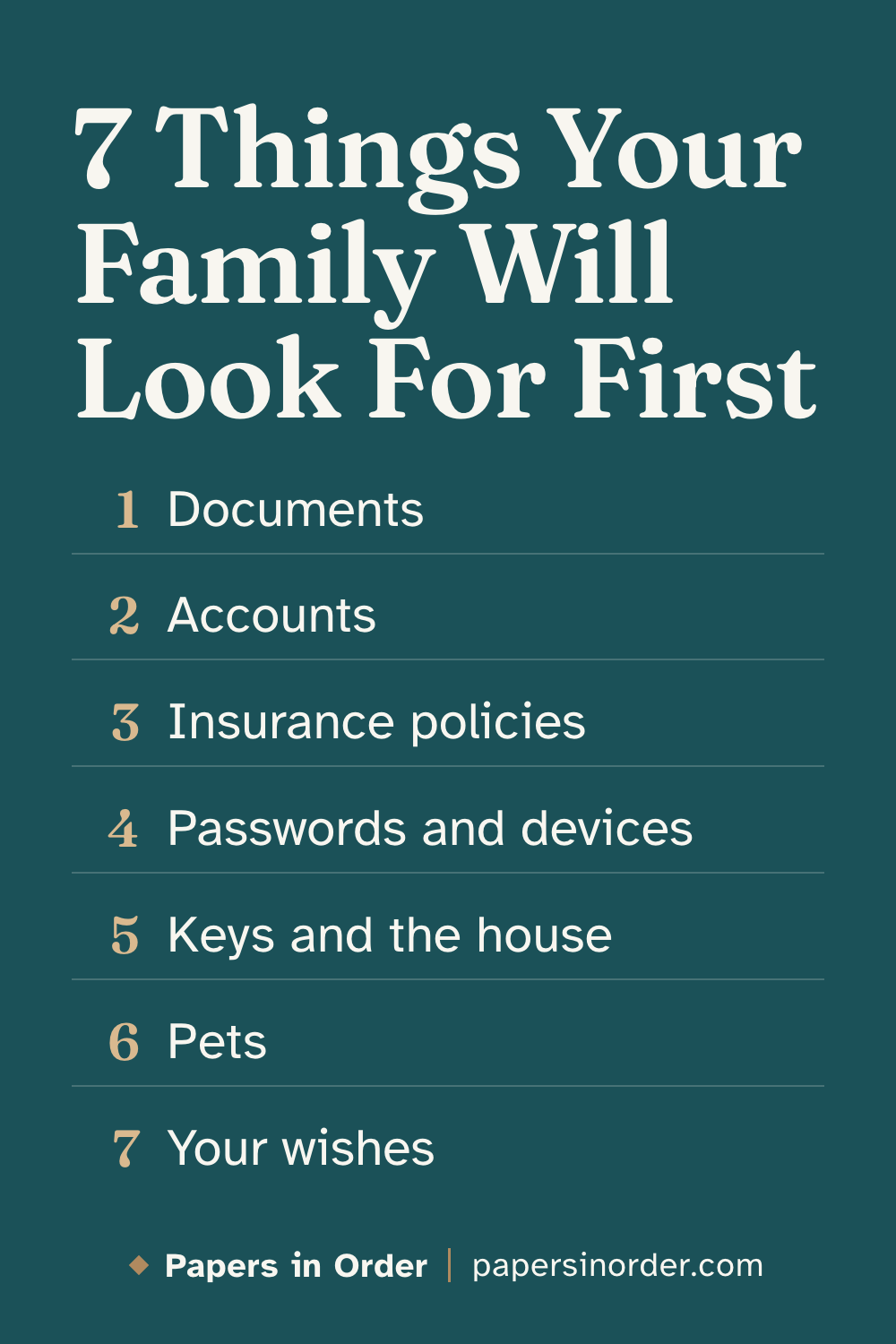
The seven things your family will look for first
When someone has to handle things for you, whether for a week in the hospital or for longer, the same questions come up in roughly the same order. Organize the binder around them.
1. Documents
Your family needs to know which important papers exist and where the originals are. This means things like birth and marriage certificates, Social Security card, passport, military service records, deed, vehicle titles, and any will, living will or power of attorney.
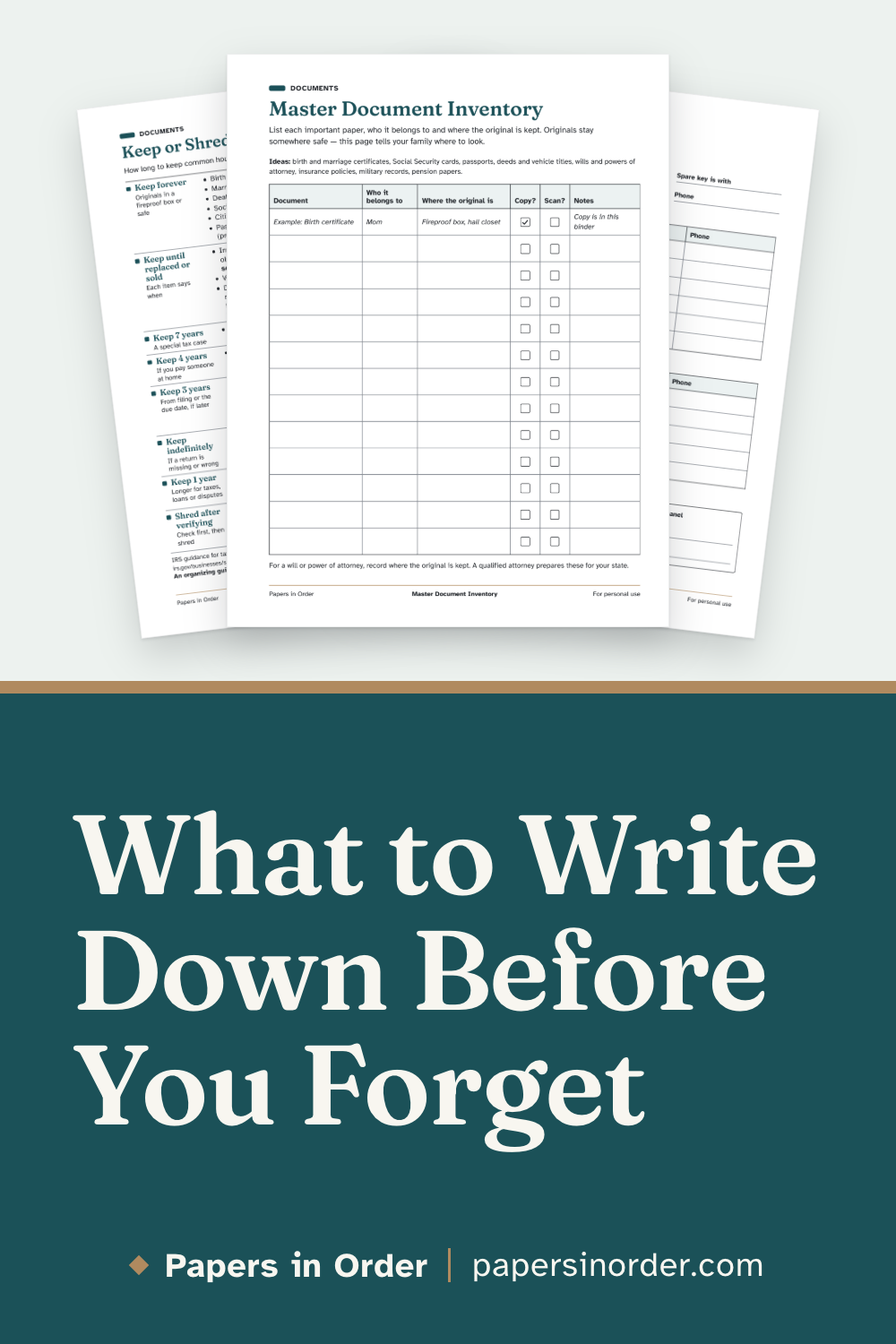
Do not put the originals in the binder. The binder holds a list: what the document is, where the original is kept, and whether a copy exists. A fireproof box, a safe deposit box and an attorney's office are all common answers.
2. Accounts
List every place money lives or comes from:
- Checking and savings accounts, with the bank name and the last four digits only
- Retirement and pension accounts
- Investment accounts
- Regular income, such as Social Security, a pension or rental income
- Bills on autopay, and which account pays them
The last item matters more than it looks. When a card is canceled or an account is frozen, autopays fail quietly. A list lets someone catch them.
3. Insurance policies
Write down each policy: the company, the type, the policy number, and the agent's phone number. Include health, life, home or renters, auto, long-term care, and any policy through an employer or a former employer.
Life insurance through an old job is easy to forget. So is a small policy bought years ago. If it is not written down, nobody may know to ask.
4. Passwords and devices
This is the one people find hardest, so start with the rule: the binder holds hints, never passwords. A page of full passwords in a binder anyone can pick up is a risk you do not need.
What goes in the binder:
- Your main email account first, since most other accounts reset through it
- Each important account: the website or company, the username or email, and a password hint only you would understand
- The name of your password manager, if you use one
For access if something happens to you, use the handover tools built for it. Apple offers Legacy Contact, Google offers Inactive Account Manager, and many password managers offer an emergency access feature. These tools are mainly for after a death or a long period of inactivity, not a short hospital stay. Each has its own rules about when access is granted. In the binder, note which of these you have set up and who you named.
One exception: a sealed envelope. Some households still want a phone passcode written down. If you do, seal it in an envelope and keep it outside the binder, somewhere a trusted person can reach without legal steps. A safe deposit box can be slow for family to open. In the binder, write only where the envelope is.
5. Keys and the house
- Where the spare house key and car keys are
- Who else has a key, such as a neighbor or a relative
- Where the alarm code is kept (or a hint), and the alarm company's number
- Where the water shut-off and the breaker box are
- Who to call for the furnace, plumbing or the landlord
6. Pets
If you live alone with a pet, this page may be the first one anybody needs. Write the pet's name, food and feeding times, any medicines prescribed by the vet, and the vet's name and number. Add the name of the person who has agreed to take the pet in an emergency. Ask them first.
7. Your wishes
This section is where you write down what you want your family to know, in your own words. Who should be told first. Which friends to call. Whether there is a clergy member, a community group or a group chat that should hear the news. Anything you would like handled a certain way.
This is not a legal document, and it does not replace one. It is a note to people who love you. If you have made formal arrangements, write down where the paperwork is and who holds it.
What this binder does not include
There is no will, power of attorney or medical directive in this binder, and the printable pages are not legal forms. These documents exist, and they matter. Rules differ by state. An attorney can prepare a will or power of attorney. For a medical directive, ask your doctor, hospital or state health department which form is valid where you live.
The binder's job is simpler: record that each document exists, where the original is kept, and who prepared it or where the form came from.
How to fill it in: three sittings of 20 minutes
You do not need a free weekend. You need three short sittings. Set a timer, stop when it rings, and pick up next time.
Sitting 1: Contacts and the house
Start with the easy pages, so you finish something on day one.
- Write the people who should be called first, with phone numbers.
- Add your doctor, your pharmacy and any attorney, accountant or financial advisor you use.
- Fill in the keys, the alarm, the pet and the house details.
Sitting 2: Documents and insurance
- Walk through the house with the binder and a pen.
- For each important document, note what it is and where the original is. Do not reorganize anything yet. Just write it down.
- List your insurance policies from the most recent statements or cards.
Sitting 3: Accounts, passwords and wishes
- Use a recent bank statement to list accounts and autopays.
- List your main accounts with hints, not passwords. Note which handover tools you have set up, and where the sealed envelope is if you keep one.
- Write a few lines under your wishes. A few lines is enough for now.
At the end, write today's date on the Start Here page. That date tells your family how current the information is.
Where to keep it, and who to tell
A binder nobody knows about does not help. Two decisions finish the job.
Where it lives. Somewhere safe but findable. A shelf in a home office, a closet or a file drawer all work. It holds personal details, so keep it somewhere private rather than out on a counter.
Who knows. Tell one or two people you trust. Say where the binder is and how to get to it. You do not have to walk them through the contents. "The blue binder in the hall closet has everything" is enough.
When to update it. Once a year is a good habit, plus any time something big changes: a new bank, a new policy, a move, a new pet. Write the new date on the Start Here page each time.
Start with ten free pages
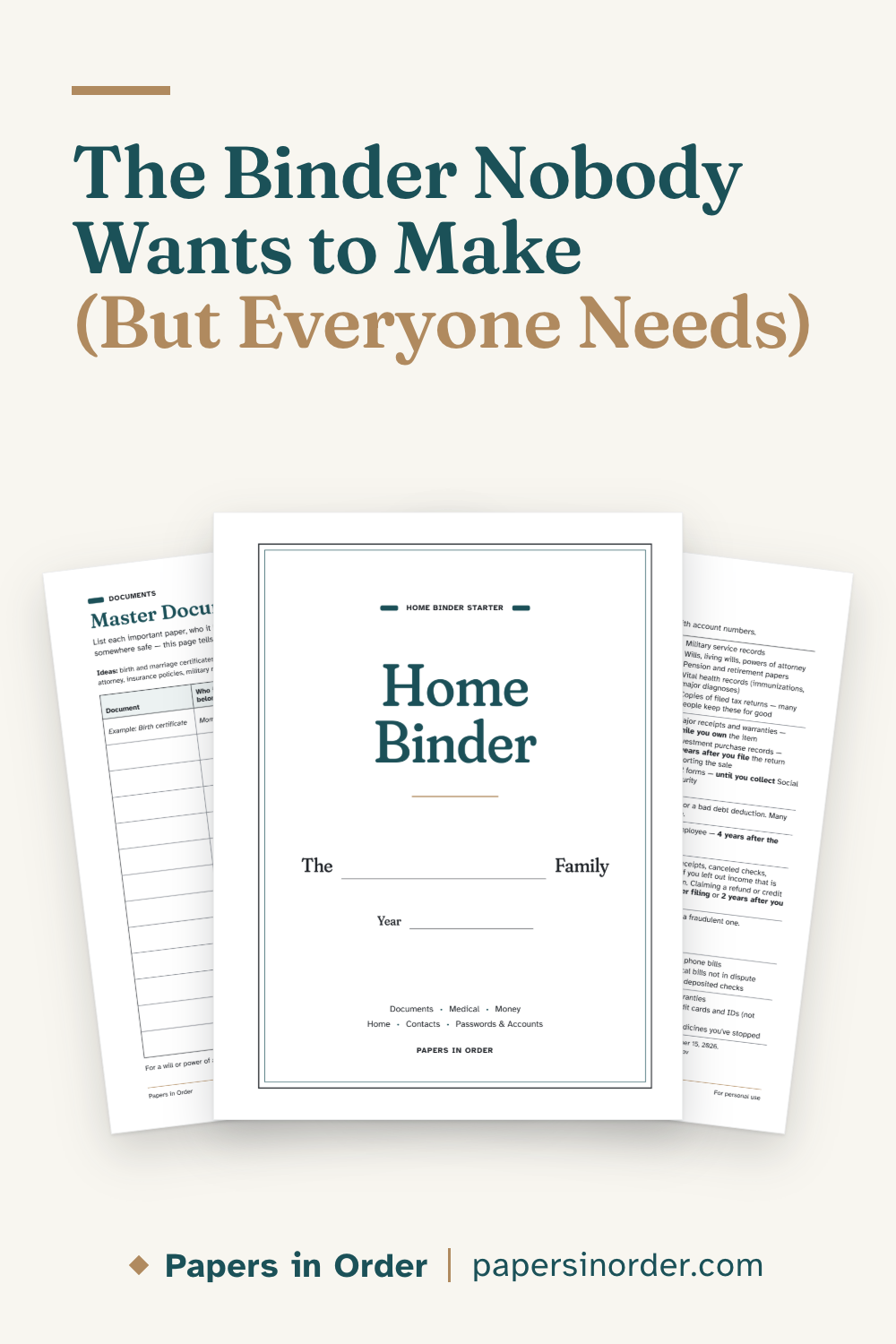
You do not need to build this from a blank notebook. Our free Home Binder Starter is ten printable pages, US Letter, made to fill in with a pen. It includes a Master Document Inventory for where the originals live, an Emergency Contacts page, a Household at a Glance page for policies and utilities, a Monthly Bills Tracker and a Password & Accounts Log. That covers documents, contacts, the house and bills. Add a plain sheet for pets and your wishes.
Print it, take the first 20-minute sitting tonight, and write today's date on the Start Here page. That is a real start.
If you are also setting up a binder for the everyday running of the house, our guide to what to put in a home management binder covers the six sections most households use.