Papers
Power Outage Preparedness: What to Have on Paper Before the Lights Go Out
A winter power outage rarely means leaving the house. It means staying in it, often in the dark, with a phone at 30 percent and a fridge you are trying not to open. The questions that come up are practical. What is the utility's outage number? How long will the freezer hold? Is Dad's insulin still good? Where is the breaker panel, and who in the house knows which switch is the main?
Every one of those answers is easier to find on paper, written on a calm day. This checklist covers what to write down before the next outage. Our emergency binder checklist covers the other kind of emergency, the one where you have to leave. This one is for staying put.
It is an organizing guide, not medical advice. In an emergency, call 911 and follow your local officials' instructions.
Start with a list of what needs power
Ready.gov's first step for a power outage is a list: "Take an inventory of the items you need that rely on electricity." Walk the house and write down each one, with a backup plan next to it.
| What needs power | Write down |
|---|---|
| Medical devices: oxygen, CPAP, a power wheelchair | The supplier's phone number and the backup battery plan |
| Medicines kept in the fridge | Which ones, and who to call about them |
| Heat | The backup heat source, and where you would go if the house gets too cold |
| A sump pump or well pump | Whether it has a battery backup |
| Phones and internet | Backup batteries, and a car charger |
| The garage door and any electric locks | How to open them by hand |
For anything medical, Ready.gov says to "Talk to your medical provider about a power outage plan for medical devices powered by electricity and refrigerated medicines," and to "Find out how long medication can be stored at higher temperatures." Write the answer on the page, so nobody has to find it in a portal with a dying phone.
The numbers to write down while the phone still works
When the power is out for a day, the phone becomes the flashlight, the radio and the clock, and its battery goes fast. Phone numbers stored only in the phone become hard to reach. Put these on paper:
- The electric company's outage line, and your account number's last 4 digits
- The gas company's leak line
- The water company's 24-hour line, and a plumber
- The heating repair company, and the propane or heating oil supplier if you have one
- An electrician
- The medical device supplier
- The nearest warming center. Ready.gov says to "Check with local officials about heating and cooling locations open near you"
- One out-of-town contact everyone checks in with
- A neighbor who checks on you, and the neighbor you check on
Our emergency contact list post covers how to lay out the family side of that page. The Utilities & Shut-Offs page in our Grab-and-Go Emergency Binder has lines for the outage, gas leak and 24-hour water numbers.
Find the shut-offs in daylight
Before an outage, find the breaker panel, the water main and the gas meter, and mark each one so someone else in the house can find it in the dark. For the electric panel, Ready.gov's safety skills page says to "always shut off all the individual circuits before shutting off the main circuit."
Leave the gas alone unless you have a reason. The Red Cross says to turn off utilities "only if you suspect damage or if local officials instruct you to do so," and Ready.gov notes that if you turn off the gas, only a qualified professional can turn it back on. If you smell gas, leave the house first and call from outside.
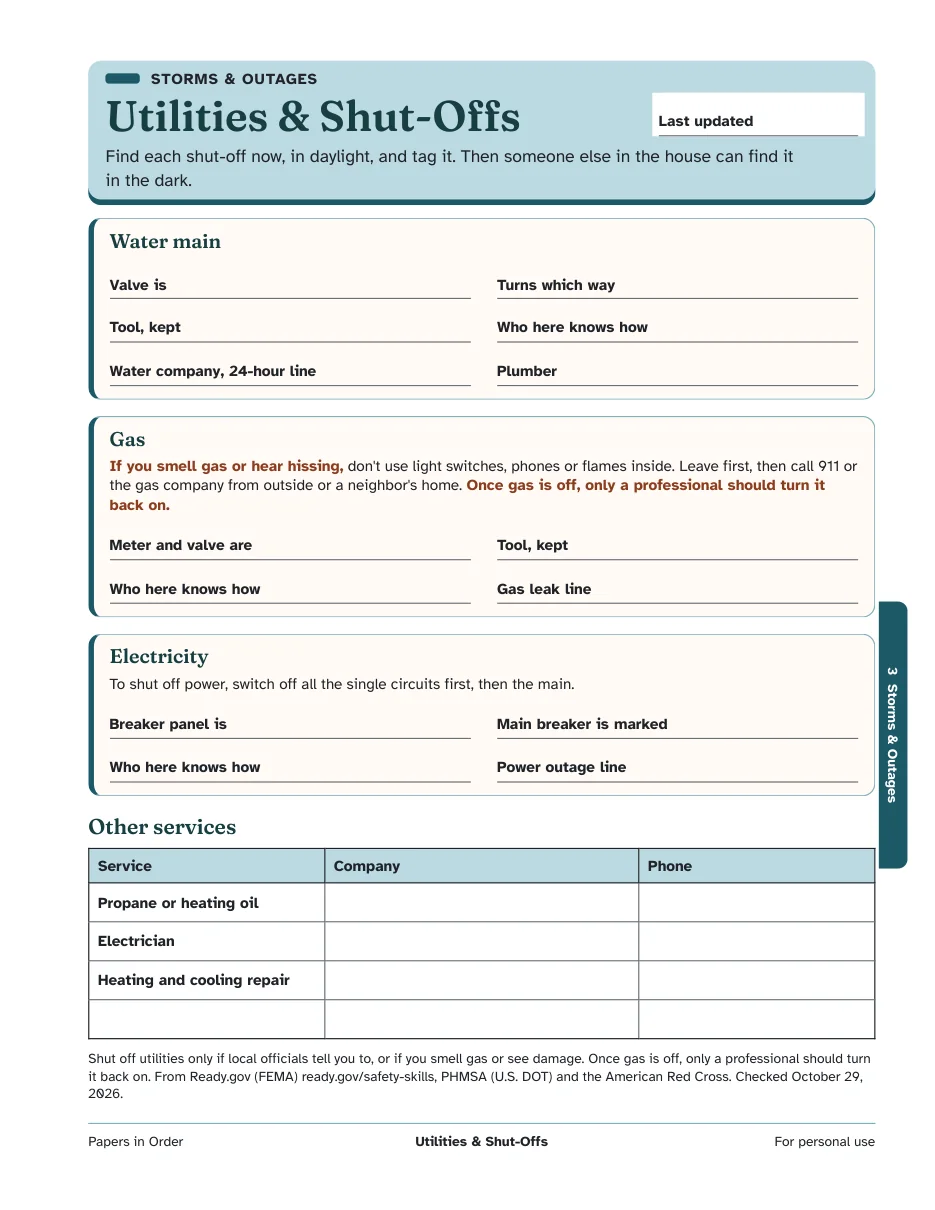
A real page from the Grab-and-Go Emergency Binder
This is the Utilities & Shut-Offs page from our Grab-and-Go Emergency Binder. Print it and fill it in by hand, or type into it on a computer.
Find each shut-off in daylight, so someone else can find it in the dark.
See all 26 pagesFridge and freezer: the numbers to tape inside the door
This is the page people look for on the second day. Ready.gov gives the timing: "The refrigerator will keep food cold for about four hours. A full freezer will keep the temperature for about 48 hours." CDC's food safety guidance, which follows USDA's rules, puts a half-full freezer at about 24 hours. Keep both doors closed as much as you can.
After four hours without power, CDC says to throw out perishable refrigerated food "such as meat, fish, eggs, milk, and leftovers." Thawed frozen food that still has ice crystals, or is at 40°F or below, can be refrozen or cooked. Never taste food to check it. Ready.gov's rule is the one to remember: "When in doubt, throw it out!"
Medicines that need the fridge
Ready.gov says to "Have alternate plans for refrigerating medicines." Write down which medicines in the house need cold storage, and who to call before throwing any of them out: the prescribing doctor or the pharmacist.
Insulin deserves its own line, because the instinct to throw it out can do more harm than the warm fridge. The FDA says insulin in the manufacturer's vials or cartridges, opened or unopened, "may be left unrefrigerated at a temperature between 59°F and 86°F for up to 28 days and continue to work." So: call your doctor or pharmacist before throwing out medicine that needs the fridge. Many insulins can be kept at room temperature (59 to 86°F) for up to 28 days, so do not stop taking insulin.
Any other question about a medicine goes to the doctor or pharmacist.
Generator and carbon monoxide rules, in one box
Carbon monoxide is one of the real dangers of an outage, because it is tempting to bring heat and power indoors. Write these rules on the page that lives near the generator and the space heater:
- Outdoors only. Ready.gov: generators "should always be used outdoors and at least 20 feet away from windows, doors and attached garages." CDC adds: never use a generator inside the home or garage, "even if doors and windows are open."
- Never into a wall outlet. The Red Cross warns, "Never try to power the house wiring by plugging the generator into a wall outlet." To connect a generator to the house, it says to have an electrician install a transfer switch.
- No stove for heat. "Do not use a gas stove or oven to heat your home." Ready.gov explains that it increases the risk of carbon monoxide poisoning.
- Alarms with batteries. Ready.gov says to install carbon monoxide detectors "with battery backup in central locations on every level of your home."
- Know the signs. CDC lists headache, dizziness, weakness, upset stomach, vomiting, chest pain and confusion. Get to fresh air right away and call 911.
- Light. "Have flashlights for every household member," says Ready.gov, and the Red Cross adds: "Use flashlights, not candles."
Keep the pipes from freezing
A long winter outage can turn into a burst pipe. The Red Cross suggests opening kitchen and bathroom cabinet doors so warm air reaches the pipes, and in very cold weather to "let the cold water drip from the faucet served by exposed pipes." If you are away, it says to leave the heat on, "set to a temperature no lower than 55° F." Write down where the water main is, so whoever finds the leak can turn it off.
A little cash, and a plan for an older parent
Card readers and ATMs need power too. Ready.gov's financial page says to "Keep a small amount of cash at home in a safe place," with small bills, "because ATMs and credit cards may not work during a disaster."
If a parent lives alone, give their house its own page: who checks on them when the power goes out, which devices they depend on, where they would go if the house gets too cold, and the numbers above for their utilities, not yours. Keep a copy at your house too, since you may be the one making the calls. Our binder's Power Outage Plan page is one place to set that down.
Ready.gov's winter page puts the goal in one line: "Gather supplies in case you need to stay home for several days without power." The paper side of that is a few pages you can read by flashlight.
Our printable for this
Our Grab-and-Go Emergency Binder is a 26-page printable, $7.99, and its Storms & Outages section was written for exactly this. A Power Outage Plan page has the what-needs-power table, the fridge and freezer times, the generator rules and the insulin note above. A Utilities & Shut-Offs page records each valve and panel and who in the house knows how to use it. A Winter Storm page covers pipes, safe heat, the car kit, and the signs of frostbite and hypothermia. The rest of the binder covers the other kind of day: contacts, a plan, a go-bag list, and what to take if you have 10 minutes, 1 hour or 1 day to leave. See the Grab-and-Go Emergency Binder.
Our $19 Home Binder Family Kit has shorter versions of the core pages in its Grab First section (emergency contacts, household at a glance, an emergency plan, a go-bag list), without the outage and storm pages. The free Home Binder Starter includes Emergency Contacts and Household at a Glance, which records the utilities and where the shut-offs are.
Print the emergency binder before the first storm
Sources: Ready.gov (FEMA) "Power Outages," "Winter Weather," "Safety Skills" and "Financial Preparedness"; CDC on carbon monoxide poisoning and on keeping food safe after an emergency (following USDA's rules); the FDA, "Information Regarding Insulin Storage and Switching Between Products in an Emergency"; and the American Red Cross pages on power outages, safe generator use and frozen pipes. Checked October 2026. An organizing guide, not medical advice. In an emergency, call 911 and follow your local officials' instructions.