Papers
Evacuation Checklist: What to Grab in 10 Minutes, in 1 Hour, and the Day Before
An evacuation checklist is most useful when it is sorted by time, because that is how an evacuation arrives. Sometimes there is a full day's warning before a hurricane. Sometimes a wildfire or a flood gives you an hour. Sometimes a knock on the door gives you ten minutes. One long list of everything you own is no help at all in the ten-minute version.
This post gives you three short lists, one for each, plus the planning that makes them work. It is an organizing guide. In an emergency call 911, and always follow your local officials' instructions. If officials say go, or you see fire or rising water, just go. Papers can be replaced.
Before any of it: know where you would go
Ready.gov's evacuation guidance starts with a plan, not a bag: "Plan how you will leave and where you will go if you are advised to evacuate." It suggests you "identify several places you could go in an emergency such as a friend's home in another town or a motel," and "choose destinations in different directions so that you have options during an emergency."
Write these down on paper, because a phone can die:
- Your evacuation zone, if your area has them. Ready.gov notes that "many states have designated evacuation zones and predetermined evacuation routes."
- Two ways out of the neighborhood, and the roads that flood or close first
- Two or three places to stay, with phone numbers, and whether they take pets
- One out-of-town contact everyone checks in with
- A meeting place near home, and one farther away
Pets need their own line. Ready.gov says "most public shelters allow only service animals," so if you have a dog or cat, write down a hotel, a friend or a boarding place that will take them.
If you have 10 minutes
This is the list to tape inside the closet door or put on top of the bag. Take the people, the pets and these things. Leave everything else.
- Everyone in the house, and the pets in carriers or on leashes
- The go-bag
- Medicines, and each person's medical information sheet
- Glasses, hearing aids, dentures, a cane or walker
- Phones, chargers and a backup battery
- Wallet, ID, keys and cash
- The emergency binder, or a waterproof pouch of copies
- Shoes and a coat for everyone, and a blanket in winter
As you go, send one short text to your out-of-town contact. A text may get through when a call will not. Ready.gov also says to follow recommended evacuation routes and "do not take shortcuts, they may be blocked," and "do not drive into flooded areas."
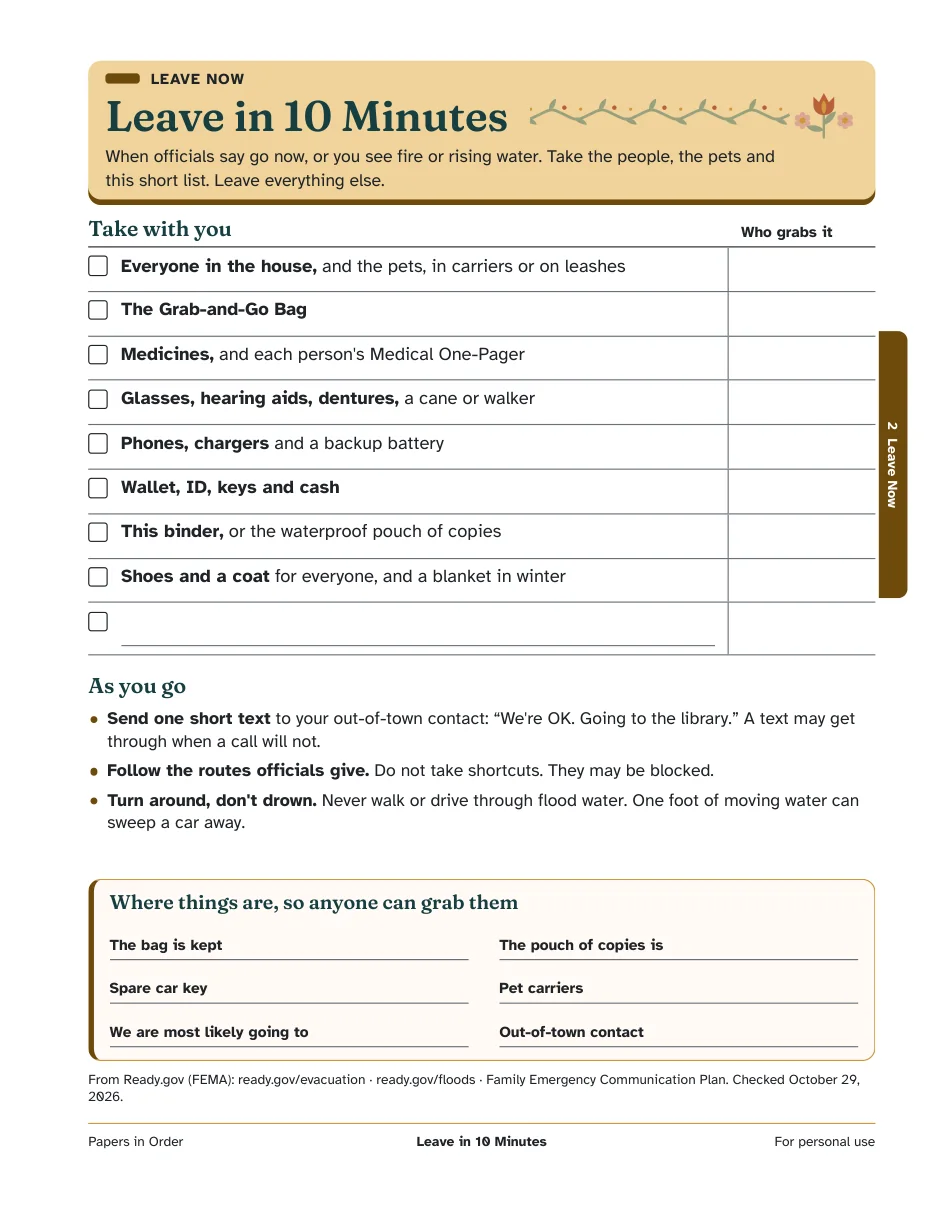
A real page from the Grab-and-Go Emergency Binder
This is the Leave in 10 Minutes page from our Grab-and-Go Emergency Binder. Print it and fill it in by hand, or type into it on a computer.
The people, the pets and a short list. Everything else can wait.
See all 26 pagesIf you have an hour
Do everything on the 10-minute list first. Our Grab-and-Go Emergency Binder has a Leave in 1 Hour page for this part. Then, if there is time, Ready.gov's guidance lists what to do before you leave:
- "Call or email the out-of-state contact in your family communications plan. Tell them where you are going."
- "Secure your home by closing and locking doors and windows."
- "Unplug electrical equipment such as radios, televisions and small appliances."
- "Leave freezers and refrigerators plugged in unless there is a risk of flooding."
- "If there is damage to your home and you are instructed to do so, shut off water, gas and electricity before leaving."
- "Leave a note telling others when you left and where you are going."
- "Wear sturdy shoes and clothing that provides some protection such as long pants, long-sleeved shirts and a hat."
- "Check with neighbors who may need a ride."
Add the things that are easy to forget in a hurry: chargers for medical devices such as a CPAP, medicines that need the fridge (in a cooler), and the pets' food, water bowl, medicine and records.
The day before: when a storm is forecast
A day's warning is a gift. Use it for what is hard to do in a hurry:
- Refill prescriptions
- Charge phones, backup batteries and medical devices
- Fill the gas tank. Ready.gov says to "keep a full tank of gas if an evacuation seems likely" and to "keep a half tank of gas in it at all times in case of an unexpected need to evacuate," because gas stations may be closed or without power
- Get some cash, in small bills
- Check that ID and insurance cards are current, and that copies are in the pouch
- Photograph every room, including inside closets and cabinets, for insurance
- Call the place you would stay, so they expect you
- Pack the bag and put it by the door, with the 10-minute list on top
If you do not have a car, Ready.gov suggests you "plan how you will leave if needed," with family, friends or your local emergency management office.
If an older parent lives alone
Ready.gov's page for older adults suggests you "create a support network of family, friends and others who can assist you during an emergency," and plan "how you will have your assistive devices with you during an evacuation." It also says to "make copies of Medicaid, Medicare, and other insurance cards."
For a parent who lives alone, that means a short, specific plan on paper: who calls her when an alert goes out, who drives, where she goes, and what she needs to bring (the walker, the oxygen, the medicine list). Put a copy in her house and one in yours. A calm holiday visit is a good time to set it up, and our aging parents checklist has more to look at while you are there.
The papers to have ready
Most of what an evacuation needs from a filing cabinet fits in one pouch of copies: photo ID, insurance cards, the policies, the medicine list, and a page of contacts. Originals stay safe at home or in a bank box. The Documents to Copy & Pack page in our Grab-and-Go Emergency Binder lists the papers to copy, with a box to tick for each copy in the pouch. Our emergency binder checklist lists exactly which papers to copy, and our guide to what to keep in a fireproof safe covers the originals.
Our printable for this
Our Grab-and-Go Emergency Binder is a 26-page printable, $7.99, built around these three time frames. Its Leave Now section has Leave in 10 Minutes (with a "Who grabs it" column, so each person has a job), Leave in 1 Hour and Leave in 1 Day, plus Routes & Places to Stay, with your evacuation zone, a main and second way out, places to stay with a "Pets OK?" column, and cut-out wallet cards for your out-of-town contact. Grab First has the Emergency Plan (meeting places, out-of-town contact, who helps whom), Emergency Contacts, a Medical One-Pager and the Grab-and-Go Bag list. Then come pages for storms and outages, hurricane and flood, wildfire, and Documents to Copy & Pack. See inside the Emergency Binder.
If you want everything in one binder, our $19 Home Binder Family Kit has the Emergency Plan and Grab-and-Go Bag pages in its Grab First section, plus medical, document and home pages. The free Home Binder Starter has an Emergency Contacts page you can fill in tonight.
Print the Emergency Binder and fill in your routes this weekend
Sources: Ready.gov (FEMA), "Evacuation" and "Older Adults." Checked November 2026. An organizing guide, not legal, financial or medical advice. In an emergency, call 911 and follow your local officials' instructions.