Papers
What to Keep in a Fireproof Safe: Papers for Home, for the Bank Box, and Copies
What to keep in a fireproof safe is one of those questions that seems simple until you are standing in front of an open safe with a pile of papers. The birth certificates, surely. The will? The passports? The car titles, the savings bonds, the spare key to the bank box? And if some of it goes to the bank instead, how will anyone find it?
This post sorts the papers into three places, using what the FDIC, FEMA and the National Institute on Aging say, and ends with the page that ties the three together. It is an organizing guide, not legal or financial advice. Where to keep an original will, in particular, depends on your state, and the FDIC itself says to ask an attorney.
Three places, three jobs
Most households have three choices, and each does a different job:
| Place | Good for | The catch |
|---|---|---|
| A fireproof safe or box at home | Papers you may need quickly, day or night | Less secure than a bank, and not proof against everything |
| A bank safe deposit box | Originals you rarely need | Only open during bank hours, and access after a death depends on state law |
| Copies somewhere else | A relative's house, a cloud folder | Copies, not originals |
The National Institute on Aging suggests putting "your important papers and copies of legal documents in one place," and adds, "For added security, you might consider getting a fireproof and waterproof safe to store your documents." Whichever you choose, the Master Locator in our Where It's Kept book records where each original is and where a copy is.
What to keep in the safe at home
The FDIC describes a home safe as a place for "replaceable items you may need immediate access to, such as a passport." That is the test: things you, or your family, might need on a weekend, at night or in an emergency.
A sensible list for the home safe:
- Passports
- Originals of powers of attorney and the health care directive (the FDIC warns against putting powers of attorney in a bank box, below)
- Your Social Security cards and Medicare cards, if you don't carry them
- Recent insurance policies, or at least the declarations pages
- A copy of the will, with a note saying where the original is
- Copies of the birth certificates and deeds whose originals are at the bank
- The spare key to the bank box, with no box number or bank name on it
- A flash drive with scans, protected with a strong password
FEMA's guide on documenting your property says to "store paper copies in a waterproof and fireproof box, safe, or bank deposit box," to "leave copies with trusted relatives or friends," and to "secure electronic copies with strong passwords and save them on a flash or external hard drive in your waterproof box or safe."
What the FDIC suggests for the bank box
For a bank safe deposit box, the FDIC's list of good candidates is specific: "originals of key documents, such as birth certificates, property deeds, car titles and U.S. Savings Bonds that haven't been converted into electronic securities." It also mentions "family keepsakes, valuable collections, pictures or videos of your home's contents for insurance purposes, and irreplaceable photos."
And what not to put there: "Be mindful not to use your bank safe deposit box to store anything you might need to access quickly or when the bank is not open. That could include passports and originals of your 'powers of attorney' that authorize others to transact business or make decisions about medical care on your behalf."
Two more points from the same FDIC article are worth knowing before you fill the box:
- Access after a death is not automatic. "The rules under which safe deposit boxes may be accessed upon the death of a safe deposit box owner depends on state law," says FDIC Counsel Richard Schwartz.
- The contents are not insured by the FDIC, and banks generally don't insure them either. If you want coverage, the FDIC suggests asking your homeowner's or renter's insurance agent.
The will and the cash: two special cases
The will. The FDIC does not give one answer, and says why: "For guidance on where to store your original will, check with an attorney about what is required or recommended based on state law." Some attorneys keep the signed original for their clients, and some states let you deposit a will with the court for safekeeping. Our post on where the will is covers the options. Whatever you choose, keep a copy in the safe with a note saying where the original is.
Cash. The FDIC is direct: "You're better off stashing your cash in a bank deposit account, like a savings account or certificate of deposit, than in a home safe or a safe deposit box," because cash outside a deposit account is not protected by FDIC insurance. Ready.gov does suggest keeping "a small amount of cash at home in a safe place" for emergencies, in small bills. A small amount is the point.
Fireproof is not everything-proof
The FDIC is careful here too: "No safe deposit box or home safe is completely protected from theft, fire, flood or other loss or damage." It suggests placing items "in water-safe, zippered plastic bags or other plastic containers that can be resealed." That costs very little and helps against the water used to put out a fire.
It also notes that "home safes are not as secure as safe deposit boxes," and quotes the FDIC's Luke W. Reynolds: "A burglar could more easily break into your home and open the safe than get inside your safe deposit box at your bank." Keep the most valuable originals at the bank, and the things you need quickly at home.
The missing piece: who can open it
A safe solves one problem and creates another. The papers are protected, and now only the person with the key or the combination can reach them. A locked safe that nobody else can open does not help a family in a hurry.
So the last step is a written record of every storage place, what is in it, and who can open it. Write who has a key or knows the combination, never the combination itself. The NIA's advice is to "tell someone you know and trust or a lawyer where to find your important papers," and it adds, "You don't need to discuss your personal affairs, but someone you trust should know where to find your papers in case of an emergency."
Three rules keep that record safe to leave in a drawer: write locations only, not what the papers say; write only the last 4 digits of any account or ID number; and never write a password, PIN or combination. Our book's Where the Password List Is page follows the same rule: where the list is and who can reach it, never the passwords.
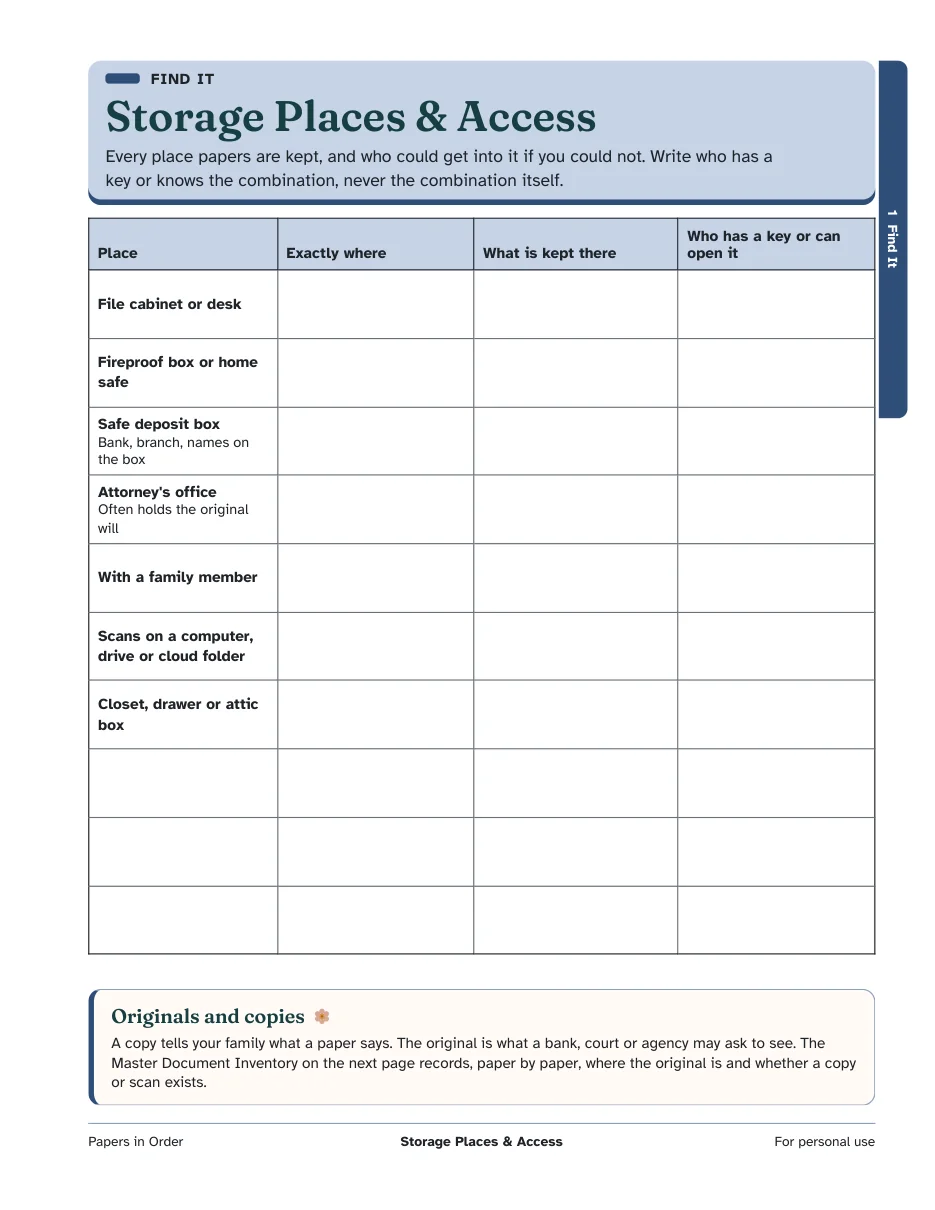
A real page from the Where It's Kept book
This is the Storage Places & Access page from our Where It's Kept book. Print it and fill it in by hand, or type into it on a computer.
Every place papers are kept, and who has a key. Never the combination.
See all 14 pagesOur printable for this
Where It's Kept is our 14-page printable, $6.99, made for exactly this. Storage Places & Access lists every place papers live (file cabinet or desk, fireproof box or home safe, safe deposit box with bank, branch and names on the box, attorney's office, a family member, scans, closet or attic box) with columns for exactly where, what is kept there, and who has a key or can open it. Safe & Safe Deposit Box records where the safe is, where its key is kept, who knows how to open it, the bank box's branch and keys, and what is in each, with "Never write the combination here" printed on the page. The Master Locator gives one line for each paper (birth certificates, Social Security cards, passports, will or trust, powers of attorney, deed, car titles, life insurance) with where the original is and where a copy is. Near the end is If You Need to Find Something, a one-page handout for the person who would have to look. See inside Where It's Kept.
If you want everything in one binder, our $19 Home Binder Family Kit has the same Safe & Safe Deposit Box page in its Important Documents section, alongside Vital Records, Property Records and Insurance Policies. The free Home Binder Starter has a Master Document Inventory and a Keep or Shred page, a good start for sorting the pile before it goes in the safe.
For which papers to keep at all, and which to shred, see important documents organization. For the photos and lists that prove what you own, see our home inventory for insurance guide.
Print Where It's Kept and fill in Storage Places & Access
Sources: the FDIC, "Five Things to Know About Safe Deposit Boxes, Home Safes and Your Valuables"; FEMA, "Document and Insure Your Property" (P-1097); the National Institute on Aging (NIH), "Getting Your Affairs in Order Checklist"; Ready.gov, "Financial Preparedness." Checked November 2026. Rules vary by state. An organizing guide, not legal, tax or financial advice.