Papers
Where Is the Will? Where Families Look First, and How to Spare Yours the Search
Ask a family what slowed them down in the weeks after a parent died, and the answer is often not a form or a phone call. It is a search. Somebody knew there was a will. Nobody knew whether the signed one was in the desk, at the lawyer's office or in a bank box that only Dad could open.
This post is about that search: where families usually look, what each of those places actually holds, and the single page that makes the search unnecessary. It is an organizing guide, not legal advice. What a will says, and what your state requires of it, is a question for an attorney.
The search usually starts in the wrong place
Most families begin at home, because that is where the papers are. The desk drawer, the filing cabinet, the closet shelf, the fireproof box in the bedroom. What they find is usually a copy, or an old draft, or the folder from the attorney with no signature inside.
A copy tells the family what the will says. The signed original is what the court will want. The National Institute on Aging's checklist for getting your affairs in order puts the distinction right in the wording. One of its lines is "Location of most up-to-date will with an original signature." Two facts in one line: which version is the current one, and where the signed paper is.
So the useful question is "where is the signed original, and who can get to it?" The answer is usually one of five places.
The five places a will usually turns up
1. At home
A filing cabinet, a desk, a home safe. Easy to reach, and easy to lose track of. If the original is at home, write down exactly where, down to the drawer and folder, and who has the key or knows how to open the safe. Never write the combination itself on the page.
2. With the attorney who drafted it
Many law offices keep the signed original for their clients. That is useful only if the family knows which attorney, and the firm still exists under that name. If your will was drafted twenty years ago, it is worth one call to confirm the office still has it.
3. In a bank safe deposit box
The FDIC's guidance on safe deposit boxes is narrower than most people expect. On where to keep a will, it says only this: "For guidance on where to store your original will, check with an attorney about what is required or recommended based on state law."
On getting into the box after a death, FDIC Counsel Richard Schwartz says who may open it "depends on state law," and that the rules "restrict entry into the safe deposit box to certain individuals and permit entry only under controlled situations." In the District of Columbia, for one example, the court's own brochure explains that someone not authorized to enter the box may need to petition for a special administrator to open it. A will in a box is safe. It can also be slow to reach. Ask your bank what applies where you live, and write the answer down.
4. On deposit with a court or register of wills
Some states let you hand the original to a county office for safekeeping while you are alive. Maryland's law is a clear example: a will "may be deposited for safekeeping" with the register of wills of the county where the person lives. During the person's lifetime, a deposited will "may be delivered only to the testator, or to a person authorized by the testator in writing to receive it." After the register learns of the death, the law says the register will open it and notify the personal representative named in it.
Other places do not take wills before death at all. The District of Columbia's probate division says plainly, "The Probate Division does not accept wills before death." So this option depends entirely on your state. Your county's probate court or register of wills can tell you in one phone call.
5. With a family member
A sister, an adult son, the person named as executor. This works if everyone else knows who has it. It fails quietly when the person holding the will is the only one who knows.
What happens to the original after a death
This is the part that explains why the search matters at all. In many places the signed original has to go to the probate court within a set time, and a photocopy will not do.
The District of Columbia's register of wills, for example, answers the question "Can I retain the original will and file a copy?" with "No. The original will must be filed with the Probate Division." Its brochure adds that the law requires a will to be filed "within 90 days after the death." Deadlines and steps differ from state to state, so the right source for your family is your own county's probate court. A family that knows where the original is can make that call with the will in hand.
Our post on what to do when someone dies covers the rest of those first weeks, one step at a time.
The fix: one page that says where everything is
None of this requires reorganizing your papers. The originals can stay exactly where they are. What is missing is a record of where they are, in one place, that a second person can read.
The NIA's advice is two short steps. Put your important papers in one place, or "list the information and location of papers in a notebook." Then "Tell someone you know and trust or a lawyer where to find your important papers." It is also reassuring about how much you have to share: "You don't need to discuss your personal affairs, but someone you trust should know where to find your papers in case of an emergency."
A locator page answers three questions for each paper:
| Question | What to write |
|---|---|
| Where is the original? | The room, the drawer, the box, the office, the bank and branch |
| Where is a copy? | In the binder, with a sibling, a scan in a named folder |
| Who can get to it? | Who has the key, who is on the box, who the attorney is |
Write locations only, never contents. A locator never says what your will says, who gets what, or how much is in an account. The Storage Places & Access page in our Where It's Kept book adds who has a key to each place, and never the combination.
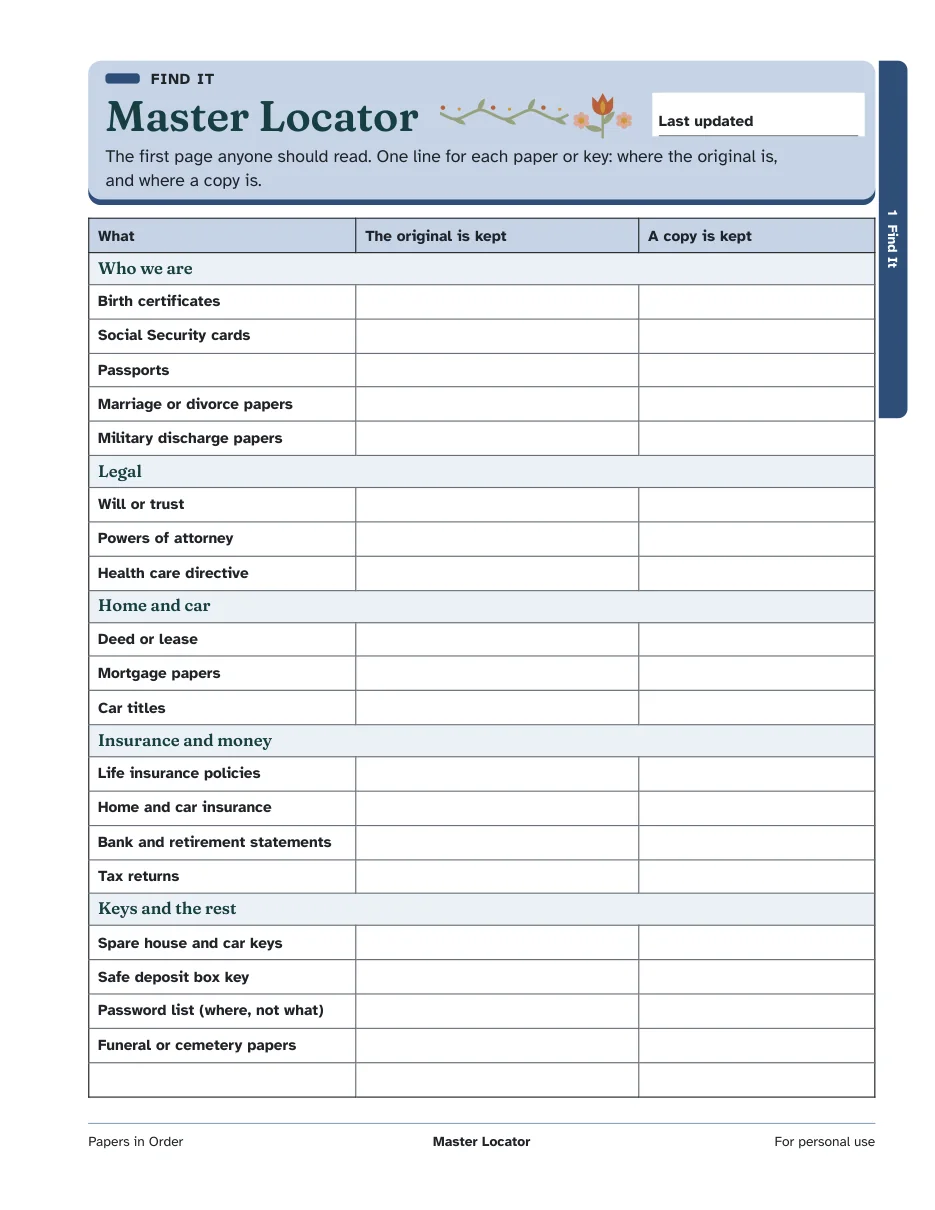
A real page from the Where It's Kept book
This is the Master Locator page from our Where It's Kept book. Print it and fill it in by hand, or type into it on a computer.
The first page anyone should read: where the original is, and where a copy is.
See all 14 pagesWalk the house with a list
The fastest way to fill in a locator is one pass through the house with a pen. Start with the papers families ask about first:
- Who we are: birth certificates, Social Security cards, passports, marriage or divorce papers, military discharge papers
- Legal: the will or trust, powers of attorney, the health care directive
- Home and car: the deed or lease, mortgage papers, car titles
- Insurance and money: life insurance policies, home and car insurance, bank and retirement statements, tax returns
- Keys and the rest: spare house and car keys, the safe deposit box key, where the password list is kept, funeral or cemetery papers
For each one, note whether the original is there and whether a copy exists. If a paper is in a bank box, the NIA has a simple rule: "keep copies in a file at home."
Three rules keep the page safe to leave in a drawer. Write the last 4 digits of any account or ID number, never the full number. Never write a password, PIN or combination; write who knows it, or where the password list is kept. And keep the page somewhere private, because anyone who reads it knows where your papers are.
Hand one page to one person
A locator in your desk still depends on someone finding your desk. The last step is a one-page handout for the person who would have to look: a son, a daughter, a sister, the executor. It says where the full record is, where the will is, who to call first, and what not to throw away. Our Where It's Kept book includes this page, If You Need to Find Something, ready to copy.
You do not have to explain anything else. You only have to tell one person that the page exists. If there is nobody in the family for this, the NIA suggests asking a lawyer.
If you are doing this for an aging parent, the holidays are a natural time to ask. Our list of questions to ask aging parents starts with exactly these: where the papers are, and who else knows.
Our printable for this
Where It's Kept is a 14-page printable from us that does exactly this job, for $6.99. It opens with a Master Locator, one line for each paper or key with columns for where the original is and where a copy is. Then a Storage Places & Access page lists every place papers live and who could open each one. There are detail pages for legal documents, vital records, property, the safe and bank box, and keys, plus a page of the people who hold papers for you (the attorney, the accountant, the insurance agent). It ends with the one-page handout described above and a yearly review log. See what's inside Where It's Kept.
If you want everything in one binder, our $19 Home Binder Family Kit includes shorter versions of the same pages in its Important Documents section, alongside medical, money and home pages. And if you would like to start for free, the free Home Binder Starter includes a Master Document Inventory page.
For the documents themselves, what each one does and where the agencies suggest keeping it, see our estate planning binder checklist. For which household papers to keep and which to shred, see important documents organization.
Look the page over once a year, and whenever something moves: a new policy, a new car, a refinance, a revised will. The NIA suggests reviewing your plans "at least once each year and when any major life event occurs." Put the date at the top each time, so your family knows how current it is.
Print Where It's Kept and fill it in this weekend
Sources: the National Institute on Aging (NIH) checklist "Getting Your Affairs in Order"; the FDIC's "Five Things to Know About Safe Deposit Boxes, Home Safes and Your Valuables"; Maryland Code, Estates and Trusts § 4-202 (deposit of wills for safekeeping); and the District of Columbia Superior Court, Probate Division, "Filing a Will in the District of Columbia." Checked October 2026. Rules vary by state. An organizing guide, not legal advice.