Papers
What to Do When Someone Dies: A Calm Checklist for the First Weeks
When someone close to you dies, the list of things that seem to need doing arrives all at once. Most of it does not need doing yet. Settling an estate usually takes months, and only a handful of steps belong in the first two days.
This checklist puts things in the order they tend to come up, with the facts we could confirm from federal agencies. It is an organizing guide, not legal, tax or financial advice. Probate and estate rules vary by state, and when in doubt the probate court clerk or an attorney is the right person to ask.
The first 48 hours
A legal pronouncement of death. The National Institute on Aging explains that a death "must be officially pronounced by someone in authority like a doctor in a hospital or nursing facility or a hospice nurse." In a hospital or nursing home, staff handle this. If the person was in hospice, the NIA says "a plan for what happens after death will likely already be in place," so the first call is to the hospice nurse.
At home without hospice, the NIA suggests talking "with the doctor, local medical examiner (coroner), local health department, or a funeral home representative" about how to proceed. If a death is unexpected, call 911.
Organ or brain donation. If the person registered as a donor, tell the doctor or nurse right away. The NIA notes that for a registered brain donor, "their point of contact will need to be notified within two hours after death."
Family, then the funeral home. The NIA calls this "the time to call those who might want to come and see the body before it is moved." Then a funeral home arranges transport; a hospital or nursing facility may help.
Keep things safe. Lock the house and the car. Find someone to feed the pets and bring in the mail. Put away cash, jewelry and medicines, and write down what you moved. Look for written funeral wishes and the will. If you find the signed original, keep it safe and unmarked. Our post on where families look for the will covers where it usually turns up.
Money, for now. Don't pay their bills from your own money, and there's no need to close accounts this week. Keep every receipt for anything you do choose to pay. The Estate Expense Log in our Executor's Checklist is a place to write each one down.
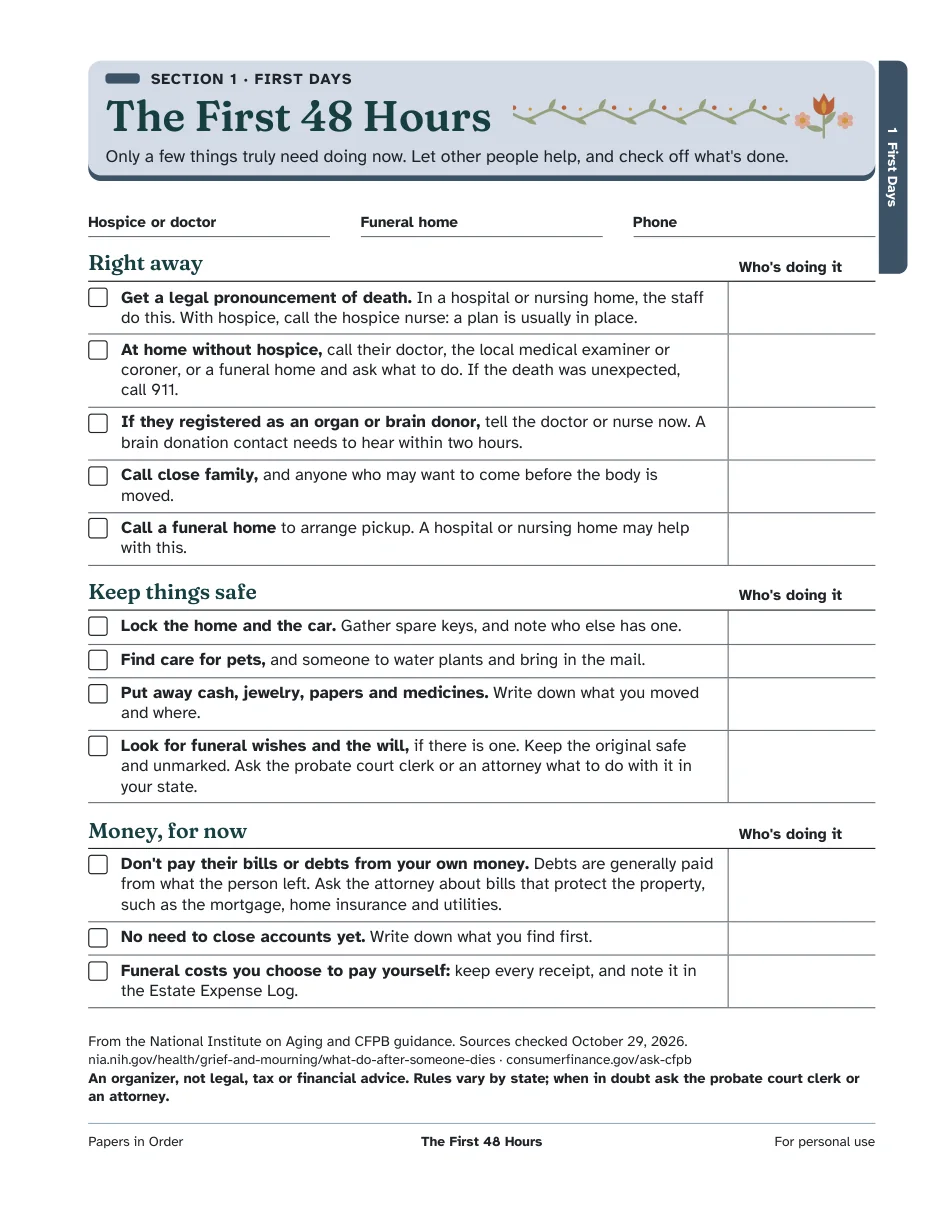
A real page from the Executor's Checklist
This is the First 48 Hours page from our Executor's Checklist. Print it and fill it in by hand, or type into it on a computer.
Only a few things truly need doing now. Let other people help.
See all 33 pagesThe first week
The funeral home and Social Security. USAGov says to "Provide the deceased person's Social Security number to the funeral director so they can report the death to the SSA." Ask the funeral director to confirm they did. If there is no funeral home involved, call Social Security at 1-800-772-1213 (TTY 1-800-325-0778). USAGov notes that the SSA does not accept death reports "by email or online."
The Social Security payment. This one surprises families. "The SSA cannot pay benefits for the month of a recipient's death." The payment for the month of death, and any that arrive after it, go back. If the person died in July, the payment that arrives in August is returned. With direct deposit, USAGov says to ask the bank to "return the payment for the month the recipient died and any that arrived later."
Death certificates. Order certified copies from the vital records office of the state where the death occurred; the funeral home can usually help. USAGov lists the tasks that need a certified copy: notifying Social Security and other agencies, "Closing or transferring credit cards and bank accounts," and "Claiming a person's life insurance or pension." A photocopy may do for smaller things, "such as canceling a subscription." There is no set number to order. Count the places that will want one, then add a couple.
The obituary. The IRS warns: "Avoid putting too much information in an obituary that identity thieves could use." A full date of birth, a home address and a mother's maiden name can all stay out.
If they were a veteran, VA benefits for burial, a headstone or marker and a burial allowance may apply. The VA's benefits line is 800-827-1000.
The mail. Forwarding all of someone's mail takes more than a death certificate. USPS asks for "documented proof that you are the appointed executor or administrator," and adds, "Simply having their death certificate is not enough."
Probate, as a question. Ask an attorney or the probate court clerk whether the estate needs probate. Many estates go through a court process; some do not, and many states have a simpler path for smaller estates. The clerk can explain the steps and forms, though not give legal advice.
Weeks two through six: telling everyone else
Once the first week is past, the work becomes a long list of calls. Spread them over days. Most of the people on the other end handle these calls every day.
USAGov's list of agencies to notify includes Social Security (which "will notify Medicare"), the IRS for the final return, the State Department to cancel a passport, the motor vehicles office for the license and any vehicle title, the local election office, and Veterans Affairs where it applies. Then come banks and credit unions, credit card companies, life insurance companies, the employer or pension plan, utilities and subscriptions.
A few things make the calls go faster:
- A certified death certificate within reach, and the person's full name, date of birth and date of death
- The statement or policy for the account you are calling about
- Court papers naming the executor, if you have them yet
- A notebook. Write the date, the name of the person you spoke with, any reference number, and what they need from you. Our Executor's Checklist has a Calls and Meetings Log for this
The NIA adds that life insurance claims need "a death certificate and policy numbers." For the credit bureaus, the NIA suggests sending copies of the death certificate to prevent identity theft.
Before canceling home, car or renters insurance, ask whether an empty house or a parked car still needs coverage. And keep the phone line until the accounts are closed, since sign-in codes may go to it.
Midway through, the work is mostly a record of calls, accounts and dates. Our Executor's Checklist is built around that record, with phone scripts and a log for every call. See the Executor's Checklist.
Debts and bills: who pays
This is the question families worry about most, and the federal answer is calmer than many expect. The CFPB says: "When someone dies, their debts are generally paid out of the money or property left in the estate." If the estate has no money, "the debts will usually go unpaid."
Family members are generally not responsible for paying from their own money. The CFPB lists the exceptions. You may be responsible if you:
- Co-signed a loan that still has a balance
- Were a joint account holder on a credit card (which is different from being an authorized user)
- Are a surviving spouse in a state whose law requires spouses to pay a particular type of debt, including community property states
- Are the executor, and state law requires a bill to be paid from property the spouses owned jointly
Debt collectors may contact a surviving spouse or the executor about the estate's debts. The CFPB is direct about the limit: "it's illegal for debt collectors to suggest you're responsible for paying from your own money" unless one of those exceptions applies.
One caution for executors in particular: don't hand anything out to heirs before the debts and claims are sorted. Paying heirs before creditors can leave an executor personally responsible. Ask the court clerk or an attorney about the order before any distribution. Ask, too, about bills that protect the property in the meantime, such as the mortgage, home insurance and utilities.
Taxes, without the jargon
The IRS says to prepare the final individual return of a deceased person "the same way you would if the person were alive." It covers income up to the date of death and is due when it would have been due anyway; for most people that is April 15 of the following year. If a refund is due, the IRS says to claim it with Form 1310.
If the estate itself earns income after the death, such as interest or rent, it may need its own return, Form 1041. That is the point where a tax professional earns their fee.
The months after
The slower work is inventory and wrap-up: listing the accounts, property, insurance, retirement accounts and digital accounts; stopping recurring payments; keeping an expense log of every cost paid by the estate or by you; and, when the court or the attorney says it is time, making distributions with signed receipts and closing the estate bank account.
None of it has to happen quickly. Write things down as you go, share the calls among family members, and stop for the day when you need to.
A binder for the person doing this
Our Executor's Checklist is a 33-page printable, $11.99, for the person settling a loved one's affairs. It follows the order of this post: First Days (the first 48 hours, the first week, death certificates, funeral notes, people to tell), Notify (what to have ready before you call, phone scripts, and checklists for government, banks, insurance and home accounts), Inventory, Paperwork & Money (taxes and key dates, probate basics, expense, mail and call logs) and Wrap-Up (distributions and a closing checklist). Facts on each page are dated and sourced to the agency they came from. Open the Executor's Checklist.
Our $19 Home Binder Family Kit does not include an executor's binder. It is for getting your own papers in order ahead of time, and it has a shorter First Week Checklist and an Accounts to Cancel page in its Everything My Family Needs to Know section. Our free Home Binder Starter is ten pages to begin that same work.
If you are planning ahead for your own family rather than handling a death now, start with an "everything my family needs to know" binder and the estate planning binder checklist.
Sources: the National Institute on Aging (NIH), "What To Do After Someone Dies"; USAGov, "Report the death of a Social Security or Medicare beneficiary," "Agencies to notify when someone dies" and "How to get a certified copy of a death certificate"; the CFPB, "Does a person's debt go away when they die?"; the IRS, "File the final income tax returns of a deceased person," "About Form 1310" and the "Identity theft guide for individuals"; USPS, "Mail for the deceased"; and the VA's burials and memorials pages. Checked October 2026. Rules vary by state; when in doubt ask the probate court clerk or an attorney. An organizing guide, not legal, tax or financial advice.