Papers
Home Inventory for Insurance: How to List Each Room Before You Ever Need to Claim
A home inventory for insurance is a simple record of what you own, room by room, made on an ordinary day so that it is ready on a bad one. After a fire, a burst pipe or a break-in, the insurance company will ask what was lost. Most people can name the big things. Very few can remember the contents of the hall closet, the brand of the dryer, or what the good china cost.
This post covers what to write down, how to take the photos, and where to keep the record so it survives whatever happens to the house. It is an organizing guide, not insurance or legal advice. What your policy covers, and how a claim works, is a question for your agent or insurance company, and rules vary by state.
Why it is worth an afternoon
FEMA's guide "Document and Insure Your Property" makes the case in two sentences: "Regardless of the type of coverage you buy, maintaining a detailed inventory of your property's contents will assist you if a disaster strikes. Your inventory will help you prove the value of what you owned, which could speed your claim processing, and will provide documentation for tax deductions you can claim for your losses."
There is a second benefit that people often miss. FEMA adds that "an up-to-date inventory can also help you to determine the correct amount of insurance to purchase." Walking the house with a list is the easiest way to find out whether your coverage still matches what you own.
What to record for each item
You don't need to list every spoon. Focus on what would be expensive or hard to replace. For each item, write:
- The room it is in
- What it is, and the brand or model
- How many
- The year you bought it, and roughly what it cost
- The serial number, for large appliances and electronics
- Whether you have a photo, and whether you have the receipt
FEMA's advice on photos is the most useful line in the whole guide: "You can take photos or videos to help you record your belongings, but be sure to also write down descriptions, including year, make, and model numbers, where appropriate." A photo shows a television. Only the written line shows which one. Our Grab-and-Go Emergency Binder has a Home Photo Inventory page for these lines.
For jewelry, art, collections and heirlooms, FEMA notes that "for valuable items, you may want to have an appraisal to determine the item's worth." Ask your agent whether those items need to be listed separately on your policy.
Take the photos room by room
Start at the front door and go clockwise through the house. In each room:
- Stand in the doorway and take one wide photo or a slow video of the whole room.
- Open closets, cabinets and drawers, and photograph what is inside.
- Take close-ups of anything valuable, and of model and serial number labels.
- Say what you are looking at as you film, if you use video.
The California Department of Insurance suggests exactly that: "Walk around with a video camera, video every drawer and comment about each item, email to someone offsite." It also notes that photos "are especially helpful when an item is hard to describe on paper, or if a purchase receipt cannot be obtained," and that each one "should be labeled with date stamps."
Don't forget the places people skip: the basement or attic, the garage and shed with the tools in it, the laundry, and the outside of the house itself.
Keep a copy outside the house
An inventory kept only in the house can burn with the house. FEMA says to "store your inventory somewhere it can be easily accessed after a disaster." The California Department of Insurance suggests "a safe place, such as a safe-deposit box, work office, or a relative's house," and adds that the records "should also include financial documents such as insurance policies and mortgage information."
A simple plan that works for most families:
- The paper list stays in your home binder
- The photos and video are saved in a named folder on your phone or computer
- A second copy goes to a relative, or into a bank box, or a cloud folder you can open from anywhere
- One page in the binder says where each copy is
The FDIC, which covers bank safe deposit boxes, lists "pictures or videos of your home's contents for insurance purposes" among the good candidates for a box.
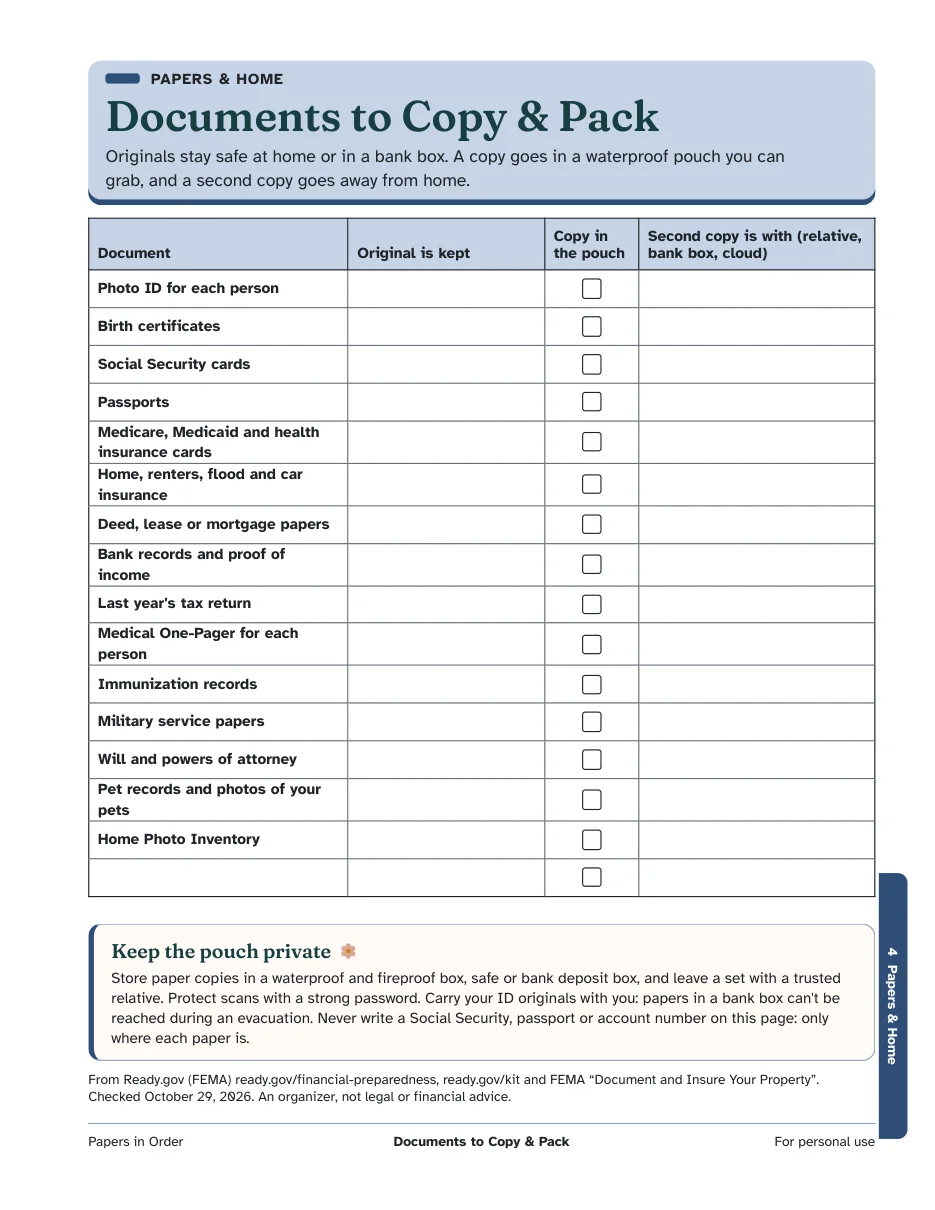
A real page from the Grab-and-Go Emergency Binder
This is the Documents to Copy & Pack page from our Grab-and-Go Emergency Binder. Print it and fill it in by hand, or type into it on a computer.
Originals stay safe. Copies go in a waterproof pouch you can grab.
See all 26 pagesUpdate it once a year
An inventory slowly goes out of date. The California Department of Insurance says "home inventories should be updated at least once per year, and your insurance company should be notified of new purchases so that you are adequately insured for the entire amount of your belongings." FEMA also suggests reviewing your policy "annually to remind yourself of your coverage and to make any updates based on new purchases, renovations, increases in property value, or increases in costs to rebuild or replace items."
The weeks after the holidays are a natural time: new things to add, receipts still in the drawer.
If you ever need to file a claim
Keep this short list with the inventory, from FEMA's guide:
- "File Claims Promptly. Many policies have time limits on when you can file a claim."
- "Save Receipts" for supplies you buy, and for hotel and restaurant costs if you have to stay somewhere else.
- "Take Pictures and Video. Record damage to your home, personal property, or vehicle."
FEMA's guidance on documenting damage also says to photograph it before you start cleaning up, inside and out. Then call the claims number on your policy. If you have written that number in your binder, you won't have to find the policy first.
Our printable for this
Our Grab-and-Go Emergency Binder is a 26-page printable, $7.99, and its Papers & Home section is built for this. Home Photo Inventory is a room-by-room checklist (living room, kitchen and appliances, bedrooms, inside closets and cabinets, basement or attic, garage, shed and tools, outside of the house, jewelry and valuables) with columns for the date the photos were taken, whether big items' year, make, model and serial number are noted, and where the receipts are kept, plus lines for where the photos are saved and who has a second copy. Insurance Policies lists each policy with its claims phone, only the last 4 digits of the policy number, and the agent. Documents to Copy & Pack tracks where every original and copy is. The rest of the binder covers contacts, leaving in a hurry, storms and outages. See inside the Emergency Binder.
If you'd like a written list of every item as well as the room checklist, our $19 Home Binder Family Kit has three Home Inventory pages, one per room (Item, Brand or model, How many, Year bought, What it cost, Photo, Receipt), plus Valuables and Appliances & Warranties. The free Home Binder Starter includes Household at a Glance, with a line for your home or renters insurance.
For the papers themselves, see our emergency binder checklist, and for where to keep the originals, our guide on what to keep in a fireproof safe.
Print the Emergency Binder and walk the house this weekend
Sources: FEMA, "Document and Insure Your Property" (P-1097); California Department of Insurance, "Home Inventory Guide"; FDIC, "Five Things to Know About Safe Deposit Boxes, Home Safes and Your Valuables." Checked November 2026. Rules vary by state. An organizing guide, not legal, insurance or financial advice.