Papers
Write Your Own Obituary: The Facts to Gather Now, and the Words Only You Can Add
To write your own obituary sounds like a strange thing to do, until you have watched a family try to write one at a kitchen table the night after a death. Someone needs the year Dad was born in Ohio, the name of the plant where he worked for thirty years, and whether his middle name was spelled with one L or two. Nobody is sure, and the funeral home is asking.
Writing your own takes that night away from them. It also means the obituary sounds like you. This post walks through the facts to gather, the part only you can write, and the few things to leave out. It is an organizing guide. Nothing here is legal advice, and your family can still change any word.
You don't have to write the finished version
Most people stall because they picture a polished newspaper notice. You don't need one. What your family needs is the raw material: the facts, spelled right, and a few sentences in your own voice. Whoever writes the final version can shape it to the length the paper or website allows.
So think of this as two pieces of paper. One holds the facts. The other holds what you would like said.
Part one: the facts your family will be asked for
These are the details an obituary is built from, and the ones families most often have to hunt for. Write them the way you would want them printed.
- Your full name, and the nickname people actually used
- The date and the city and state where you were born
- Your parents' names
- Your brothers and sisters
- Your spouse or partner, and the date you married
- Your children and grandchildren, and their spouses if you'd like them named
- The places you have lived
- School, and the work you did
- Military service, your faith, and the clubs or groups that mattered to you
- What you loved doing
- Which paper or website you would like the obituary to appear in
- The photo you'd like used, and where it is
That last line saves more trouble than it looks. Pick the photo now, write down where it is (the album, the frame on the dresser, a named folder on the computer), and your family will not spend an evening going through boxes.
If you are not sure of a date, write what you know and mark it with a question mark. A family can confirm one date. They cannot rebuild a whole life story from scratch.
Part two: the words only you can add
The facts tell people who you were. These lines tell them what you were like. Answer any of these that come easily, and skip the rest.
- What are you proudest of?
- How would you like to be remembered?
- What would surprise people who only knew you later in life?
- Is there a saying, a joke or a line you were known for?
- Who would you like thanked: a caregiver, a neighbor, a nurse, a church?
- Is there a charity you'd like named for gifts instead of flowers?
Write the way you talk. A sentence like "She never met a garage sale she didn't like" says more than a paragraph of dates, and nobody else can write it for you.
If you find it easier to talk than to write, ask a son, a daughter or a grandchild to sit with you and write down what you say, word for word. Read it back. Change what doesn't sound like you.
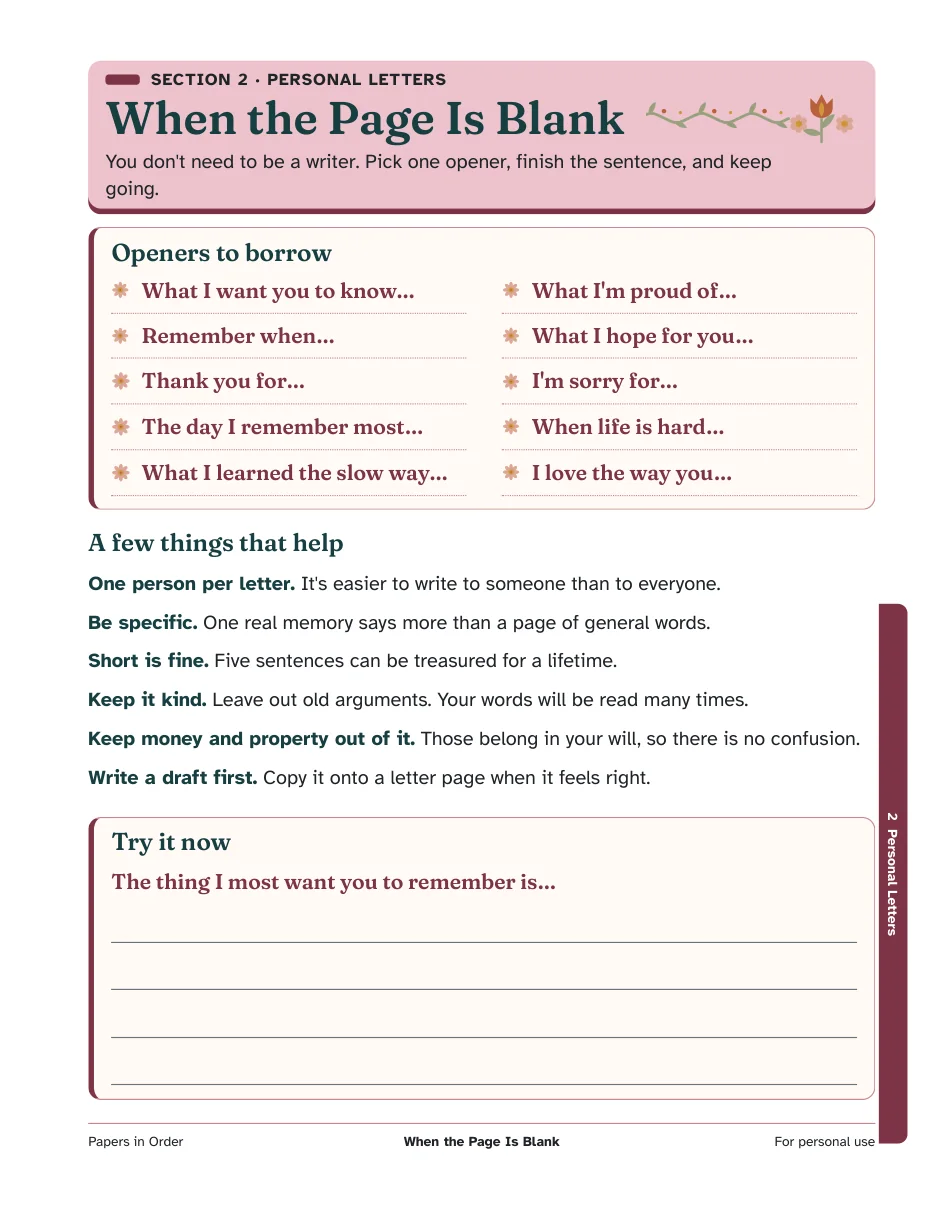
A real page from the Letter to My Family
This is the When the Page Is Blank page from our Letter to My Family. Print it and fill it in by hand, or type into it on a computer.
Openers to borrow, and a few things that help.
See all 22 pagesWhat to leave out
An obituary is public, and some of what goes into one is exactly what someone needs to open an account in your name. The IRS identity theft guide says it plainly, in its advice on deceased person identity theft: "Avoid putting too much information in an obituary that identity thieves could use."
In practice, that means leaving out:
- Your full date of birth (the month and year, or just your age, is enough)
- Your home address
- Your mother's maiden name, a detail sometimes used to confirm who you are
You can still name your mother. Just don't pair her maiden name with your full birth date in the same notice. Your family can decide how much detail feels right; a short note on your draft saying "please leave out my birthday and address" makes the choice easy for them.
The practical lines that go with it
An obituary usually sits alongside a few other decisions, and it helps to write them on the same page or the one beside it:
- Whether you would like a funeral, a memorial, a celebration of life or no service at all
- Music, readings and who you'd like to speak
- Flowers, or donations to a named charity
Our final wishes checklist walks through those choices one at a time, and what a funeral home must tell your family under the FTC's Funeral Rule.
Where to keep it
A draft obituary only helps if someone finds it in the first day or two. Keep it with your other papers for family, not sealed away where it will be opened weeks later. Then tell one person where it is: the person most likely to sit down with the funeral home. The Where My Papers Are page in our Letter to My Family is a good place to note where the draft is.
Look it over every year or two. Grandchildren get born, people marry, you take up a new hobby or move. Put the date at the top each time, so your family knows how current it is.
If you want to tell the longer story
An obituary has room for a few hundred words. Many people find, once they start, that they have far more to say: where they grew up, how they met, the year everything changed. That longer story is worth keeping too, just not in the newspaper.
If that is you, or a parent you are helping, our My Life Story workbook is a guided memory book for exactly that, with prompts chapter by chapter. See the My Life Story workbook. Our list of questions to ask your mom about her life is a gentle place to begin.
Our printable for this
Letter to My Family is our 22-page large-print printable, $7.99, for the things your family will need to hear from you. Its page The Service I'd Like has a section called "For my obituary: things I'd like said," next to music, readings, people you'd like to speak, flowers or donations, and what you'd like to wear, with the identity theft note printed on the page. My Funeral Wishes covers burial or cremation and the kind of service. Then come the practical pages (What to Do First, Where My Papers Are, People Who Help Me) and the Personal Letters section, which opens with a page called When the Page Is Blank for anyone who freezes at the first line. See inside Letter to My Family.
If you want the facts list itself as a printed page, our $19 Home Binder Family Kit includes My Story, a page of facts and memories "for an obituary or a eulogy, in my own words," with lines for every fact listed above, from Full name and Nickname to Photo I'd like used, and where it is. It sits beside My Wishes and A Letter to My Family in the kit's Everything My Family Needs to Know section. To start for free, the free Home Binder Starter has ten pages, including emergency contacts.
Start your Letter to My Family
Sources: the IRS, "Identity theft guide for individuals" (deceased person identity theft). Checked November 2026. The facts list is our own organizing list; the examples of what to leave out are ours. This is not a will and does not replace one. An organizing guide, not legal, tax or financial advice.