Papers
Final Wishes Checklist: Burial or Cremation, the Service, and Who Should Know
A final wishes checklist is a short list of the decisions your family would otherwise have to make for you, usually within a day or two, and usually while they are grieving. Burial or cremation. A funeral, a memorial or nothing formal at all. Which hymn, which reading, who speaks. None of it is hard to answer on a quiet afternoon. All of it is hard to guess.
This post walks through the checklist one decision at a time, what the federal Funeral Rule says your family can ask a funeral home for, and where to keep the page so it is read in time. It is an organizing guide, not legal or financial advice. Wishes written on a checklist are not legally binding, and rules for funerals, cemeteries and prepaid plans vary by state.
Why write it down at all
The Federal Trade Commission's guide to planning your own funeral puts the reason simply: "Thinking ahead can help you make informed and thoughtful decisions about funeral arrangements." Planning ahead also lets you choose the items you want and compare prices from several funeral providers, something few families have time to do in the week after a death.
There is a second reason, and it matters just as much. When nobody knows what you wanted, the person who decides carries that choice alone, and sometimes siblings disagree. A page in your own handwriting settles it. You can be as brief as you like. "Cremation, a small service at church, and please play Amazing Grace" is a complete answer.
The checklist, one decision at a time
1. Your body
Start with the decision every family is asked first. Our Letter to My Family has a My Funeral Wishes page and a page called The Service I'd Like for writing these answers down.
- Burial
- Cremation
- Green burial
- Donating your body to science
- My family decides
Then the place: the cemetery and plot, if you own one, or where you would like ashes scattered or kept. If you already own a plot, write down where the deed or plot papers are. The FTC notes that "an important consideration when planning a funeral pre-need is where the remains will be buried, entombed, or scattered."
2. The kind of service
- A funeral, with the body present
- A memorial service
- A celebration of life
- Graveside only
- Family only
- No service
Add where you would like it held and who you would like to lead it: a pastor, a rabbi, a friend, a family member.
3. The details that make it feel like you
This is the part families remember, and the part they most often have to guess.
- Music you would like played
- Readings, poems or prayers
- People you would like to speak
- Anyone who should be sure to be invited
- Flowers, or a charity for donations instead
- What you would like to wear, or have with you
Leave blank anything you don't mind about. A blank tells your family they are free to choose.
4. Arrangements already made
If you have talked with a funeral home, prepaid anything or bought a plot, this line saves your family the most trouble. Write:
- The funeral home's name and phone number
- Whether it is prepaid, arranged but not paid, or not arranged
- Where the contract or receipt is kept
Prepaid plans are governed by state law. The FTC's planning guide says "protections vary widely from state to state, and some state laws offer little or no effective protection." The paperwork itself says what is covered, so your family needs to know where it is.
5. If you served in the military
Write down your branch and where your discharge papers are kept. The VA explains that eligible veterans "have earned VA burial and memorial benefits for themselves, their spouses, and qualifying family members," including burial in a national cemetery, a headstone or marker, and a burial allowance. You can also apply for a pre-need eligibility decision letter, which the VA says "can help you pre-plan for burial in a VA national cemetery, and make the process easier for your family members in their time of need." The VA benefits hotline is 800-827-1000.
What the Funeral Rule lets your family ask for
A checklist works best when your family also knows their rights at the funeral home. The FTC's Funeral Rule gives every consumer a few protections, and they are worth writing on the back of your page:
- "Funeral directors must give you price information on the telephone if you ask for it."
- "The funeral home must give you a General Price List (GPL) that is yours to keep."
- "Buy only the funeral arrangements you want."
- The funeral provider "cannot refuse to handle a casket or urn you bought online" or from another seller.
- "No state law requires routine embalming for every death."
- "No state or local law requires the use of a casket for cremation."
None of this means your family has to shop around. It means they can ask for the price list first, and choose only what fits your wishes and their budget. Our letter of instruction guide covers the rest of what a family needs to hear from you, beyond the funeral.
Where to keep it so it is read in time
This is where many careful plans go wrong. The FTC is direct about it: "Put your preferences in writing, give copies to family members and your attorney, and keep a copy in a handy place." And: "Don't designate your preferences in your will, because a will often is not found or read until after the funeral."
The same guide warns against keeping the only copy in a safe deposit box, because a family may need to act on a weekend or holiday, before the box can be opened. Funeral decisions are usually made within days. A will is often read weeks later.
So the page belongs somewhere a family member would look on the first day:
- In your home binder, behind a tab marked for family
- With a copy given to the person most likely to make the arrangements
- With a note in your Where It's Kept locator or document list saying where the original is
If you are not sure where your other papers are, our post on where the will is covers the search families usually face, and how to end it with one page.
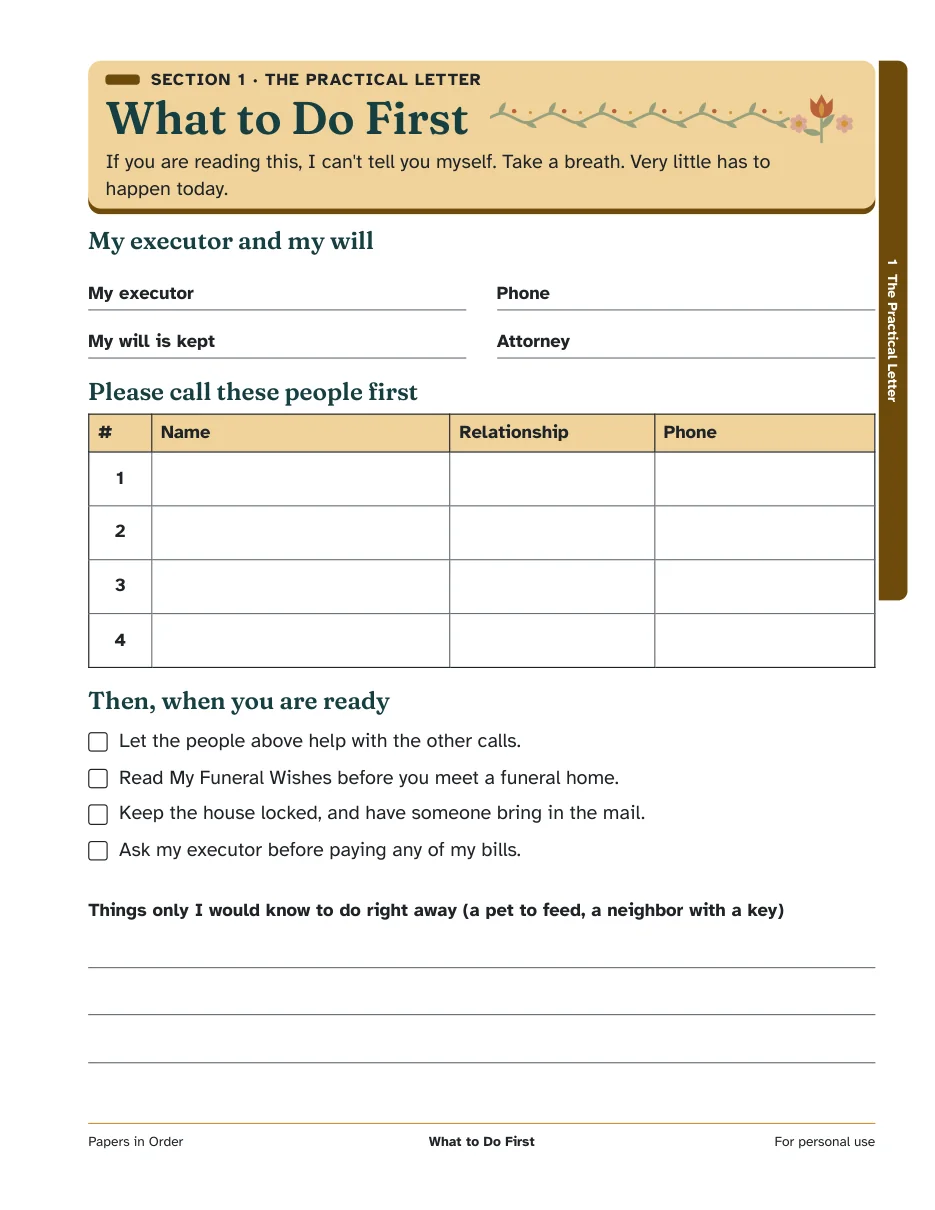
A real page from the Letter to My Family
This is the What to Do First page from our Letter to My Family. Print it and fill it in by hand, or type into it on a computer.
Your executor, where the will is kept, and who to call first.
See all 22 pagesTalk about it once, out loud
Writing the page is the main work. Telling one person that it exists is the other half. The FTC suggests you "review and revise your decisions every few years, and to make sure your family is aware of your wishes."
If you are helping an aging parent with this, it does not need to be a solemn sit-down. Many families find it easier to start sideways, with a favorite hymn or a song they would want played, and let the bigger questions follow. Our list of questions to ask aging parents has gentle ways to open the subject, and if your parent would like to write their own obituary too, our guide on how to write your own obituary goes through it fact by fact.
Our printable for this
Letter to My Family is our 22-page large-print printable, $7.99, and it holds this checklist on two pages. My Funeral Wishes has tick boxes for My body (Burial, Cremation, Green burial, Donate to science, My family decides), A service (Funeral, Memorial, Celebration of life, Graveside only, Family only, No service), where and who leads it, whether anything is prepaid or arranged ahead, the funeral home, and where the papers are kept, with the Funeral Rule price-list note printed on the page. The Service I'd Like covers music, readings, poems or prayers, people you'd like to speak, who to be sure to invite, flowers or donations, what you'd like to wear, and things you'd like said in your obituary. The rest of the book is a practical letter (What to Do First, Where My Papers Are, People Who Help Me) and personal letters to the people you love. See inside Letter to My Family.
If you want everything in one binder, our $19 Home Binder Family Kit has a My Wishes page with the same service and body choices, plus My Story, A Letter to My Family and Who Gets What, alongside medical, money and home pages. To start for free, the free Home Binder Starter has ten pages, including emergency contacts and a document inventory.
Look the page over every few years, and whenever something changes: a move, a new church, a plot bought, a plan prepaid. Put the date at the top each time.
Write your final wishes in Letter to My Family
Sources: the FTC, "Planning Your Own Funeral" and "The FTC Funeral Rule"; the U.S. Department of Veterans Affairs, "Burials and memorials." Checked November 2026. Wishes written on a checklist are not legally binding, and rules vary by state. This is not a will and does not replace one. An organizing guide, not legal, tax or financial advice.