Papers
Letter of Instruction: What to Put in a Letter to Your Family (It Isn't a Will)
A will answers legal questions: who inherits, who is in charge, who raises the children. It does not say which neighbor has a key, that the dog takes a pill with breakfast, or that the electric bill comes out of the joint checking account on the 15th. Families need those answers too, usually in the first few days, and usually from someone who can no longer give them.
A letter of instruction is where those answers go. It is a plain letter, in your own words, that tells your family what to do first, who to call and where things are. Many people add a second part: the personal letters they want their family to keep.
First, what it is not
A letter of instruction is not a will, and it does not replace one. It is not legally binding. It cannot change who inherits, who your executor is, or who becomes guardian of your children. Those things live in legal documents drafted under your state's rules, and if you want something to be binding, talk to an attorney about putting it there.
That limit is also the letter's strength. Because it carries no legal weight, you can write it at the kitchen table, in pencil, and change it whenever you like. Nothing in it should contradict your will. If you ever notice that it does, the will is the document to fix, with your attorney.
This post is an organizing guide, not legal, tax or financial advice.
The practical half: what your family will ask first
The practical letter is short pages, each answering one question your family will have. Write the way you would explain it on the phone.
What to do first
Open with the people to call, in order, with phone numbers: your executor, then two or three people who can help with everything else. Then the handful of things only you would know need doing right away: a pet to feed, a neighbor to tell, a delivery to cancel. A line like "very little has to happen today" is a kindness to whoever reads it.
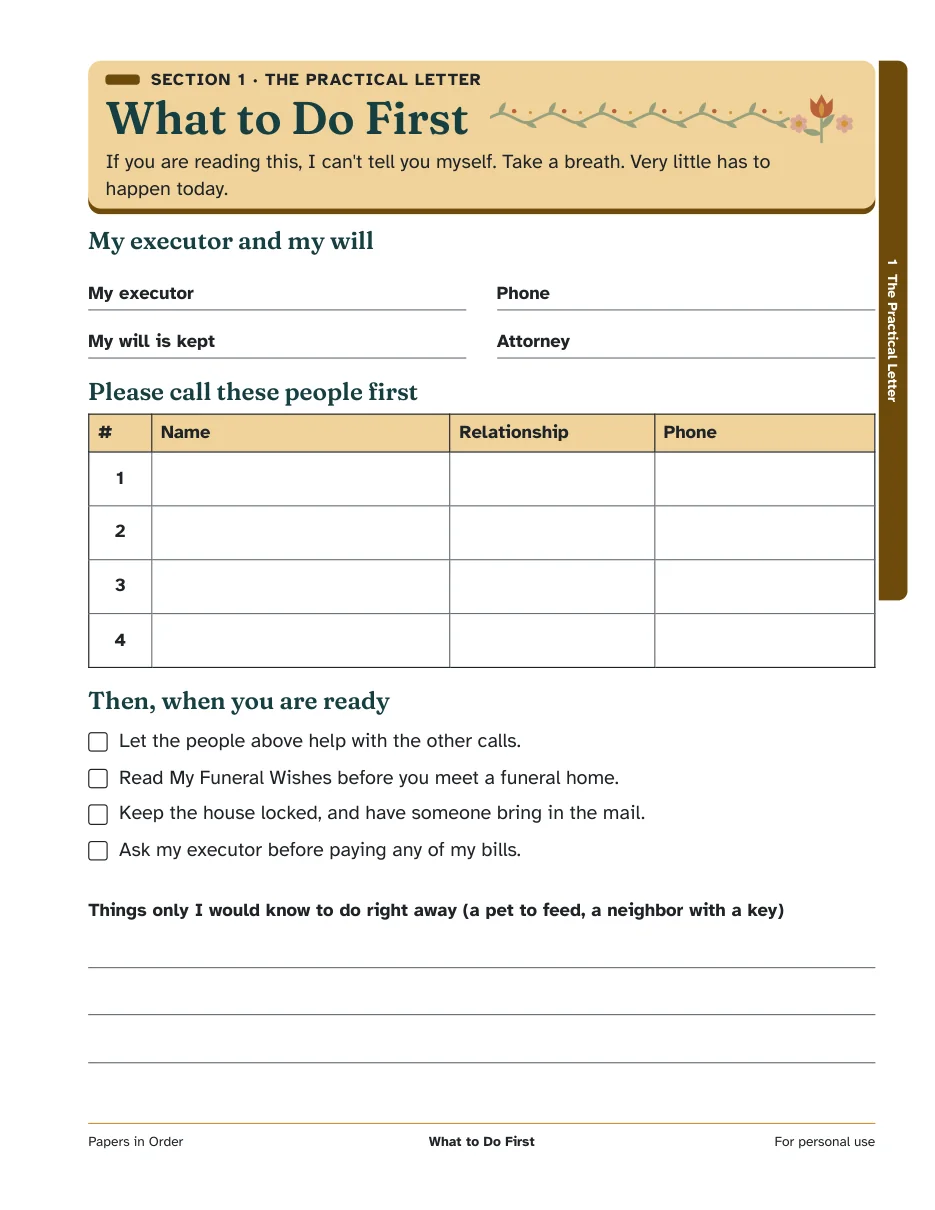
A real page from the Letter to My Family
This is the What to Do First page from our Letter to My Family. Print it and fill it in by hand, or type into it on a computer.
Your executor, where the will is kept, and who to call first.
See all 22 pagesWhere the papers are
Not what the papers say, only where they are. The will and any trust, powers of attorney and health care papers, birth and marriage certificates, insurance policies, the deed or lease, car titles, the safe deposit box and its key, funeral or cemetery papers, tax returns, military discharge papers. If you have made a fuller list of where things are kept, say where that list is. Our post on where families look for the will explains why the location of the signed original matters so much.
The people who help you
Names and phone numbers only: the attorney, the accountant or tax preparer, the financial advisor, the insurance agent, your bank, your doctor, a faith leader, the funeral home if you have one in mind, a trusted neighbor. These people already have the details. Your family only needs to know who they are.
Accounts and bills
List each bank or company, the kind of account, and the last 4 digits of the number. Never the full number, and never a password; say where your password list is kept and who can open it. For bills, note how each one is paid. Automatic payments keep going until someone stops them, so it helps to flag which ones protect the house or car, like insurance, and should not be stopped in a hurry.
Home, car and pets
Who has a spare key. Where the water shut-off and fuse box are. Where the car title is and who you would like the car to go to. For each pet: the vet, the food and the routine, and who you would like to take them. That last line is a wish, and it helps a great deal to ask that person first.
Funeral wishes
The National Institute on Aging says simply: "Put your preferences in writing and give copies to your loved ones." Burial or cremation, the kind of service, where, and who you would like to lead it. Music, readings, who to invite. If you have arranged or prepaid anything, say with which funeral home and where the papers are. The FTC's advice on planning your own funeral is to "tell your family about the plans you've made; let them know where the documents are filed." It also notes that protections for prepaid plans "vary widely from state to state."
Two things worth writing down for your family's sake. Under the FTC's Funeral Rule, a funeral home must give a General Price List that is yours to keep, and you can buy only the items you want. And for the obituary, the IRS advises: "Avoid putting too much information in an obituary that identity thieves could use." A full date of birth, a home address and a mother's maiden name can stay out.
Your digital life
For each account that matters (email, photos, social media, the phone plan), say what you would like done: keep it, close it, or turn it into a memorial page. Some services let you name a person ahead of time. Apple's Legacy Contact is "someone you choose to have access to certain data in your Apple Account after your death," and Google's Inactive Account Manager covers "the event of the user's death or inactivity." If you set either up, note it in the letter.
Belongings with a story
The quilt, the watch, the recipe box. Who you would like to have each one, and why. Mark this page clearly as wishes, not gifts. If something must go to a certain person, that belongs in your will. Our Letter to My Family has a Belongings With a Story page for this.
The personal half: the letters people keep
The practical letter gets used for a few months. The personal letters get read for years. The NIA, writing about sharing wishes with family, lists "writing a letter" as one way to do it. A personal letter is the same idea, aimed at one person.
What stops most people is the blank page. Our Letter to My Family has a page of openers to borrow for that moment. A few things help:
- One person per letter. It is far easier to write to your daughter than to "my family."
- Start with an opener. "What I want you to know…" "Remember when…" "What I'm proud of…" "What I hope for you…" Finish the sentence and keep going.
- One real memory. A specific afternoon says more than a page of general words.
- Short is fine. Five sentences can be treasured for a lifetime.
- Keep it kind. Leave old arguments out. These words will be read many times.
- Keep money and property out. Those belong in your will, so there is no confusion about what you meant.
A four-part shape works for almost anyone: something you want them to know, something you are proud of, a memory you share, and a hope for them. Sign it the way they know you.
When the letters are written, write on each envelope who it is for and when to open it: after you are gone, on a birthday, on a wedding day. Then note where each letter is kept, so every one reaches the right person.
Helping a parent write theirs
If your parent would rather talk than write, sit beside them and write down what they say, in their own words. Read it back. Their voice matters more than neat handwriting. Starting with the easy pages (the people who help, the bills) is usually gentler than starting with funeral wishes.
The holidays are often when these conversations happen naturally. Our list of questions to ask aging parents covers how to begin without making it feel like a deadline.
Where to keep it, and who to tell
Keep the letter with your other papers, somewhere private, and tell one person where it is. The point of a letter of instruction is that it is found on the first day, not the tenth. Look it over once a year, on a date you will remember: update phone numbers, add new accounts, cross out closed ones, and add a letter for anyone new in the family.
Our printable for this
Letter to My Family is a 22-page large-print printable, $7.99, built in exactly these two halves. The Practical Letter has pages for What to Do First, Where My Papers Are, People Who Help Me, My Accounts at a Glance, Bills and Payments, Home, Car and Pets, My Funeral Wishes, The Service I'd Like, My Digital Life and Belongings With a Story. Personal Letters opens with a page called When the Page Is Blank, a short example letter, a guided four-part letter, and pages for a partner, each child and each grandchild, plus a page recording where every letter is kept. See inside Letter to My Family.
Our $19 Home Binder Family Kit has shorter versions of these pages in its Everything My Family Needs to Know section, including Where Things Are, Who to Call First, My Wishes and a Letter to My Family page. To start for free, the free Home Binder Starter has ten pages, including emergency contacts and a document inventory. For the wider version of this binder, see an "everything my family needs to know" binder.
Start your Letter to My Family
Sources: the National Institute on Aging (NIH), "Getting Your Affairs in Order Checklist" and "Advance Care Planning: Advance Directives for Health Care"; the FTC, "The FTC Funeral Rule" and "Planning Your Own Funeral"; the IRS, "Identity theft guide for individuals"; Apple Support on Legacy Contact and Google Account Help on Inactive Account Manager. Checked October 2026. This is not a will and does not replace one. An organizing guide, not legal, tax or financial advice.