Caregiving
Caregiver Checklist: Daily, Weekly and Monthly Tasks for Helping a Parent
When you start helping a parent, the work does not arrive as a list. It arrives as a hundred small things at once. A pill organizer. A missed call from the pharmacy. A fridge that needs checking. A sibling asking how things are going. A caregiver checklist is how you turn that pile into something you can see.
It will not make the work lighter. It does make it visible. Once the tasks are written down and sorted by how often they happen, you stop carrying them in your head, and other people can pick some of them up.
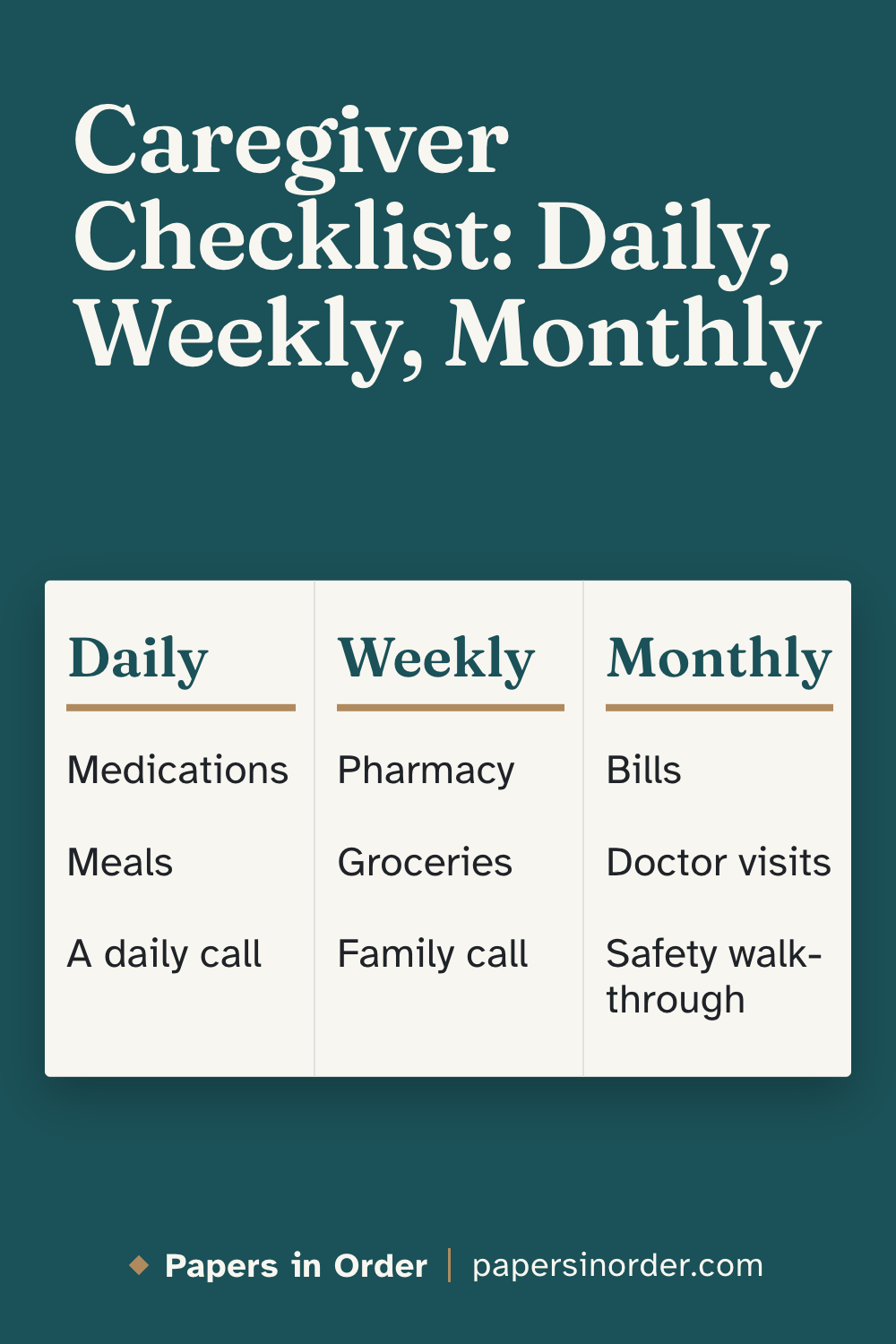
This post sorts the usual tasks into three groups: daily, weekly and monthly. Then it covers the one page you hand to whoever fills in for you, and how to tell when it is time to ask for more help.
One thing first. This is an organizing guide. It is not medical advice. Anything about which medicines to take, how much, or when belongs to your parent's doctor, pharmacist or care team. The checklist below helps you keep track of what they decided. It does not replace them.
Daily tasks
Daily tasks are the ones that go wrong fastest if nobody notices. Keep this list short enough that you can check it in two minutes.
Medications
- Give or remind about medications at the times written on the current list from the doctor or pharmacist.
- Check the box or initial a log once each dose is taken, so nobody doubles up.
- Note anything that seemed off, and keep the note for the next call with the doctor or pharmacist.
The goal here is tracking, not deciding. If you are not sure whether a dose should be taken, skipped or changed, call the pharmacist or the doctor's office. Do not guess.
Food and water
- Make sure there was a real meal, not only snacks.
- Check that a drink is within reach, especially on hot days, unless their care team has limited fluids.
- Glance at the fridge for anything past its date.
Movement
- Note whether your parent got up and moved around today, in whatever way their care team has said is right for them.
- Keep walkways clear of shoes, cords and bags.
Connection
- One real conversation a day. A visit, a phone call or a video call all count.
- Write down anything your parent asked you to follow up on.
A small notebook by the door works well for all of this. The next person who comes in can read what happened today in thirty seconds.
Weekly tasks
Weekly tasks keep the house running. They are also the easiest ones to share with siblings, friends or neighbors, because they can happen on any day of the week.
| Task | What it covers | Can someone else do it? |
|---|---|---|
| Pharmacy | Pick up refills, ask about anything due soon | Yes |
| Groceries | Staples, easy meals, drinks | Yes |
| Cleaning | Kitchen, bathroom, trash, laundry, bed sheets | Yes, or a paid service |
| Pill organizer | Refill it from the current list, if that is your job | Only someone the family agrees on |
| Open it, pull out bills and anything official | Yes, with a place to put it | |
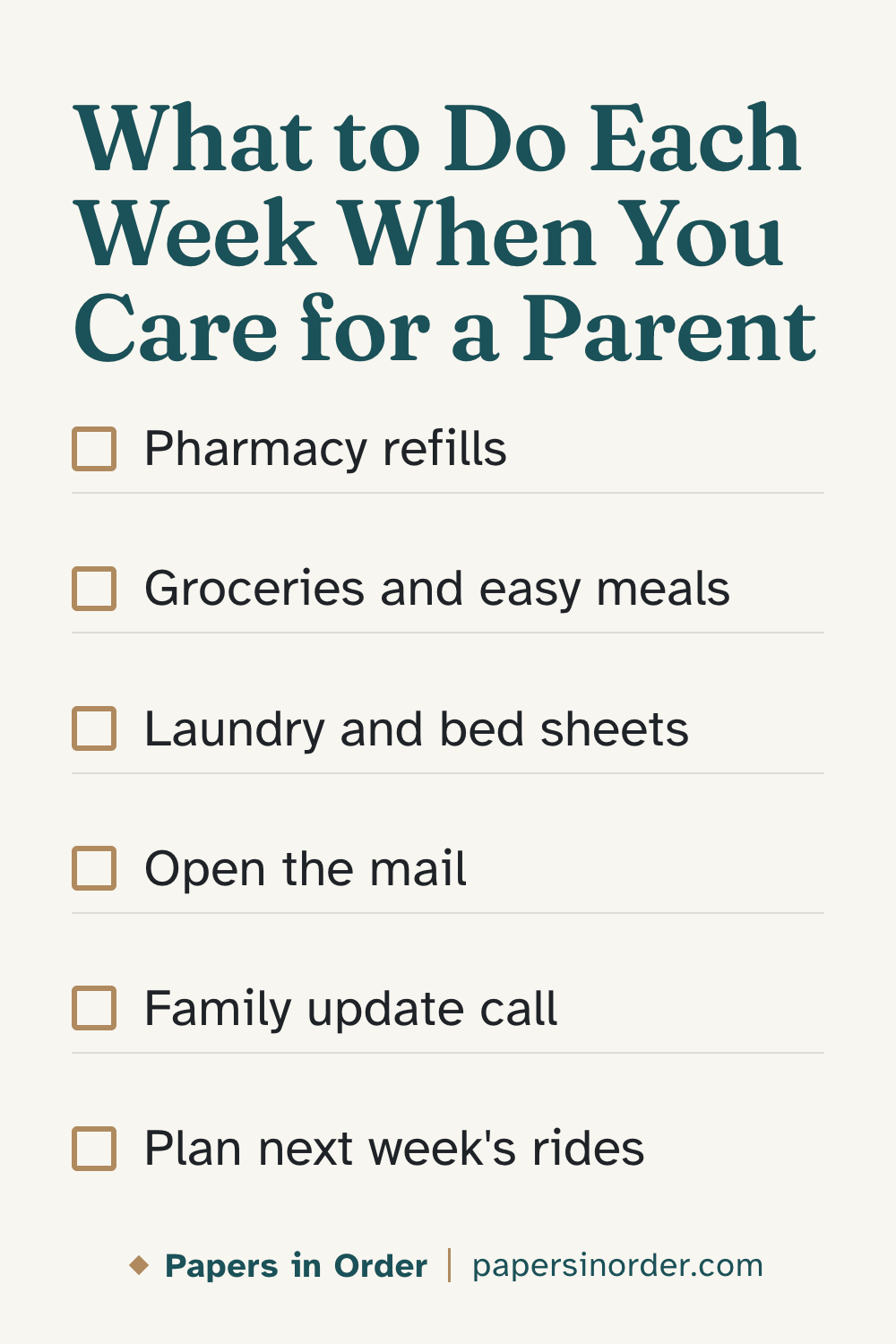
| Family call | Short update to siblings or other helpers | Whoever is the main caregiver |
| Next week | Look at the calendar for appointments and rides | Yes |
The weekly family call
This is the task people skip, and it heads off a lot of arguments. Keep it to fifteen minutes. Cover three things:
- What happened this week.
- What is coming next week, and who is driving.
- One task someone else can take off the main caregiver's plate.
If your family is spread out, a group text with the same three points works too. The point is that nobody has to piece it together from rumors.
Pharmacy day
Pick one day for pharmacy runs and stick to it. Ask the pharmacy whether your parent's refills can be synced to one pickup date. Many pharmacies offer this, though not every medicine qualifies. Fewer trips means fewer chances for something to run out.
Monthly tasks
Monthly tasks are the paperwork and the bigger checks. Put a reminder on the same date each month, such as the first Sunday.
Bills
- List every bill that comes due this month: rent or mortgage, utilities, phone, insurance, subscriptions.
- Note which account pays each one and whether it is on autopay.
- Check the bank statement for anything you do not recognize.
A monthly bills tracker page keeps this on one sheet instead of in a stack of envelopes. There is one in our free binder starter.
Appointments
- Put every doctor, dentist, eye and hearing appointment for the coming month on one calendar.
- Arrange rides ahead of time.
- Bring the current medication list and a short list of questions to each visit.
Supplies
- Check stock of anything that runs out quietly: incontinence supplies, batteries for hearing aids, paper towels, toilet paper, pet food.
- Order ahead so nothing needs a late-night store run.
Home safety walk-through
Walk through the home once a month with fresh eyes. This is about the house, not about your parent's health.
- Test smoke and carbon monoxide alarms.
- Check that hallways, stairs and the bathroom have working lights, including night lights.
- Look for loose rugs, cords across walkways and clutter on the stairs.
- Make sure the emergency contact list on the fridge is current.
- Confirm that a spare key is where the family thinks it is.
Paperwork check
- File any new insurance letters, explanations of benefits and statements.
- Update the medication list in the binder if the doctor or pharmacist changed anything.
- Note any new contacts, such as a new specialist or home aide.
One page for whoever covers your shift
Sooner or later, someone else will step in. A sibling for a weekend. A neighbor for an afternoon. A paid aide for a week while you travel. They will not have your memory of how things work.
Give them one page. Not a binder, not a long email. One page they can read standing in the kitchen.
What goes on it:
- Who to call first. Your number, a backup family member, and the primary doctor's office.
- Emergencies. Call 911 for an emergency. For a possible poisoning, Poison Control is 1-800-222-1222, free and open all day and night. Call 911 instead if the person collapses, has a seizure, can't breathe or can't wake up.
- The daily routine. Wake-up time, meals, rest, bedtime. Short lines, not paragraphs.
- Medications. Where the current list is kept and where the medicines are. Do not rewrite doses onto the handoff sheet. Point to the list from the doctor or pharmacist, so there is only one version.
- Food. Likes, dislikes, and any diet the care team has set.
- The house. Where the spare key, the flashlight and the breaker box are. How the thermostat works.
- Pets. Feeding times and the vet's number, if there is a pet.
- What not to worry about. The small habits that look odd but are normal for your parent. This saves you a lot of worried phone calls.
Put the date at the top. Update it when something changes. Keep a copy on the fridge and one in the binder.
The free starter includes an Emergency Contacts page for the refrigerator door and a Medical One-Pager for medications, allergies and doctors. Together they cover most of what a stand-in needs. Get the free ten pages here.
When it is time to ask for help
This part is about you, not your parent. Caregiving can grow slowly, one task at a time, until it takes more than one person has.
Some plain signs that the load has outgrown you:
- The daily list regularly does not get finished.
- You are missing your own appointments, shifts at work or sleep.
- You dread the phone ringing.
- You have not had a full day off in weeks.
- Tasks are being done by whoever happens to notice, with no plan.
None of these mean you are doing it wrong. They mean the job has changed size.
Where to look for support
- Family first. Use the weekly call to hand off specific tasks, not general requests. "Can you take pharmacy runs on Saturdays" works better than "let me know if you can help."
- The Eldercare Locator. A free public service from the U.S. Administration for Community Living. It connects older adults and their families with local services, such as meal programs, rides and caregiver support. Visit eldercare.acl.gov or call 1-800-677-1116.
- Your parent's care team. Ask the doctor's office what support they can point you to. They often know local options.
Asking early is easier than asking in a crisis. The checklist you already have makes it easier too, because you can show exactly which tasks need another pair of hands.
Put it in the binder
A checklist works best when it lives in the same place as everything else: the medication list, the contacts, the bills. That way, anyone who helps can open one binder and find what they need.
Our free Home Binder Starter is ten printable pages, US Letter, made to fill in with a pen. It includes emergency contacts, a medical one-pager, a monthly bills tracker and a document inventory. Print it tonight, fill in the contacts page first, and you will already have the core of a handoff sheet.
If your parent has not yet written down where their important documents and accounts are, our guide to an 'everything my family needs to know' binder walks through it in three short sittings.
Download the free binder starter