Papers
Medical Binder Printables: How to Track a Family's Health Records
A medical binder is the answer to a question asked in waiting rooms all over the country: "And what is she taking?" If you track health information for more than one person, that question arrives without warning, usually while you are standing up.
This post covers what goes in a medical binder, how to get copies of your records, and how to keep it current.
One thing first, as everywhere we touch health information. This is an organizing guide, not medical advice. What medicine to take, how much and when belongs to the doctor, pharmacist or care team. The binder's one job is to record what they decided, where anyone can find it.
What a medical binder is for
It is not a copy of your medical chart. It is the short version: who the people are, what they take, who treats them, what insurance pays, and where the full records live. Four situations shape what goes in it.
- An appointment. You need the current medication list and last week's questions.
- A new provider. They want history, allergies, medications and who else treats this person.
- A hospital or urgent care trip. Somebody needs facts fast, possibly not you.
- A hand-off. A sibling, neighbor or paid aide takes over with none of your memory.
If a page would not help in one of those four, leave it out.
One page per person
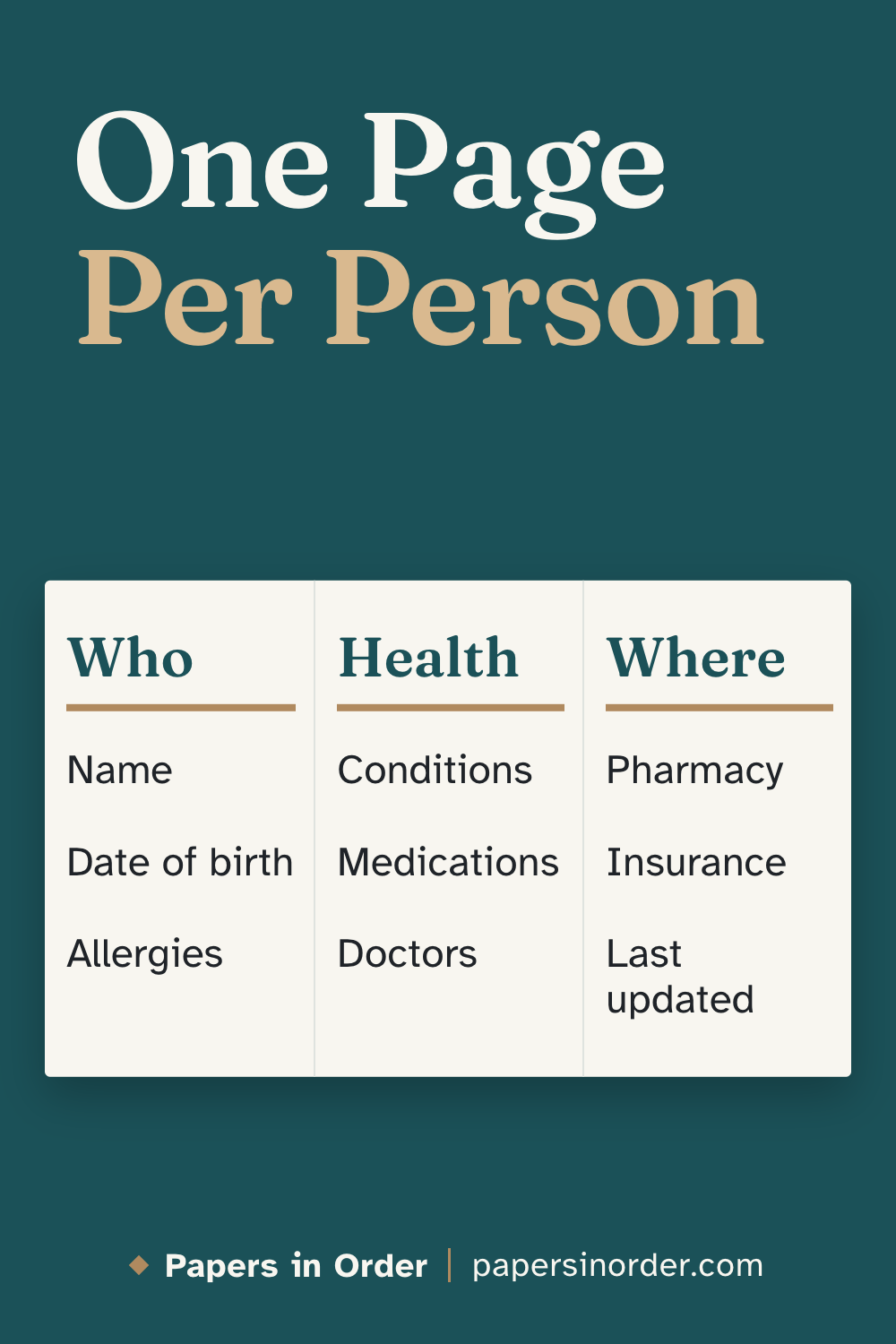
This is the heart of it. One sheet per household member, in a sheet protector, at the front of that person's section.
MedlinePlus, from the National Library of Medicine, suggests a personal health record start with:
- Your name, birth date, blood type, and emergency contact information
- Date of last physical
- Dates and results of tests and screenings
- Major illnesses and surgeries, with dates
- A list of your medicines and supplements, the dosages, and how long you have taken them
- Any allergies
- Any chronic diseases
- Any history of illnesses in your family
For a binder used in a hurry, add three lines: the preferred hospital, the pharmacy with its number, and the doctors with specialty and number. Then put a "last updated" date at the top. An out-of-date medical page causes as much trouble as no page, and the date tells a stranger how far to trust it. Use pencil for what changes, and print a fresh page when it gets unreadable.
The medication list
Once a person takes more than three or four things, give this its own sheet — four columns ruled on plain paper will do. The ones that earn their space:
| Column | What goes in it |
|---|---|
| Medicine | The name as printed on the bottle, brand and generic if both appear |
| Dose and when | Exactly as the label reads |
| Prescriber | Which doctor, so a question goes to the right office |
| Started | Roughly, so you can answer "how long has she been on that?" |
Include over-the-counter medicines, vitamins and supplements. They are easy to leave off and often exactly what a provider is asking about, so they earn their line.
Update this page from the pharmacy label, not from memory. When a dose changes, cross out the old line and write a new one, so for a week or two you can see what changed. Anything you are unsure about goes to the pharmacist or the doctor's office, not into the binder as a guess.
The appointment log
Another sheet you rule yourself. Two lines per visit in date order, and you never again reconstruct a year of care from memory:
- Before: date, time, who, where, and the questions you want answered.
- After: what was decided, what changed, what was ordered, and when to come back.
The "after" half is what siblings and other providers need. It also catches what falls between offices — the referral nobody made, the test ordered and never scheduled. One log for the whole household beats one per person; you usually remember roughly when something happened.
Insurance, Medicare and the cards
One page per person for coverage: the company, plan name, member ID, group number, the phone number on the back of the card, and the pharmacy benefit if it is separate.
If Medicare is involved, a few specifics from Medicare.gov are the ones families most often get wrong:
- Your Medicare Number "is unique to you — it's not your Social Security Number."
- With Original Medicare, Medicare says to "Carry your Medicare card with you when you're away from home" and show it when you get services, plus the plan card if you have a drug plan or supplemental coverage.
- With a Medicare Advantage Plan or other Medicare health plan, "You'll use your plan's card to get services, not your Medicare card." Medicare says to keep the Medicare card somewhere safe in case you switch plans or return to Original Medicare later.
- Give the Medicare Number only to providers, insurers and plans and people you trust who work with Medicare. On unsolicited calls, Medicare is blunt: "Medicare will never call you uninvited and ask you to give us personal or private information."
So which card travels depends on the plan: the Medicare card with Original Medicare, the plan's own card with Medicare Advantage. Whichever is in the wallet, the binder holds photocopies of all of them, readable when the wallet is not in the room. Ready.gov's guidance for older adults says the same for a different reason: "Make copies of Medicaid, Medicare, and other insurance cards."
Getting the actual records
At some point the binder is not enough and you need the real file. For your own records, federal law says you can ask. The Office of the National Coordinator for Health Information Technology, part of HHS, puts it this way in its guide to health records: "A federal law called the Health Insurance Portability and Accountability Act (HIPAA) Privacy Rule gives you the right to see and get a copy of your health record. Health plans and most providers — including most doctors' offices, clinics, hospitals, pharmacies, labs, and nursing homes — must follow this law."
Everything below is about that right — your records, requested by you. Getting another adult's records is a different question. It turns on paperwork that person signs and on state law, and this post does not cover it: ask that provider's office what they need, or an attorney. What the ONC guide does say is that it "also supports caregivers, those serving as a health care proxy for a minor child or an elderly parent" — which is about helping someone use the process, not about who is entitled to what.
What requesting your own records looks like in practice:
- Start with the patient portal. Some of what you need — immunizations, test results — may already be there.
- Ask for a partial record. Records run to hundreds of pages. You can request specific parts: allergies, medications, immunizations, notes from a single visit, test results or X-rays.
- Expect up to 30 days. "According to the HIPAA Privacy Rule, your health care provider can take up to 30 days to deliver your health record." If they need longer, they must give a reason and a new date, and can take up to 30 extra days. Some state laws set shorter timelines.
- There may be a fee. Records sent electronically through a portal, an app or email "likely will be free," but a provider "may charge a reasonable fee to cover only the cost of making or mailing paper or electronic copies."
- Ask each office how they do it. The guide notes that "Every office may have its own system for record keeping" and that each "may require you to follow a different process" — though a provider "cannot impose unreasonable barriers to your access, or unreasonably delay you from getting your records."
Keep a page of what you asked for, from whom, when, and whether it arrived. Requests get lost, and a date on paper lets you follow up without an argument.
Check what comes back
The same guide recommends reading records for mistakes, and lists what to check: personal and insurance details, appointment notes, medical history, symptoms, immunizations, conditions, allergies, medicines, tests, surgeries and procedures. It also suggests comparing bills with your plan's explanations of benefits.
If something is wrong, ask the provider to correct it; their office will have a process or a form. Per the guide, "Your healthcare provider has 60 days to respond to your request, unless they ask for an extension (extra time)." Note the request and the reply, with dates.
What to grab on the way out
A thin folder inside the binder, so it leaves the house without repacking:
- The one-pager for that person, and the current medication list
- Photocopies of the insurance, Medicare and pharmacy cards
- The primary doctor's name and number, and anyone else treating this person
- The emergency contacts page, and a note of where the full records and any signed legal documents are kept
For an emergency, call 911. The binder is for the hour after, when someone is asked what she takes and who treats her.
Keeping it current
A medical binder goes stale faster than any other part of a home binder, which is why its pages stay short. Ten minutes a month, on bills day:
- Compare the medication list against the actual bottles on the shelf.
- Write in anything from last month's appointments that did not get logged.
- Update the "last updated" date on each one-pager, check whether any insurance card or plan changed, and reprint anything too marked up to read.
That is the whole job. The binder that stays trustworthy is the one small enough to check.
The free pages to start with
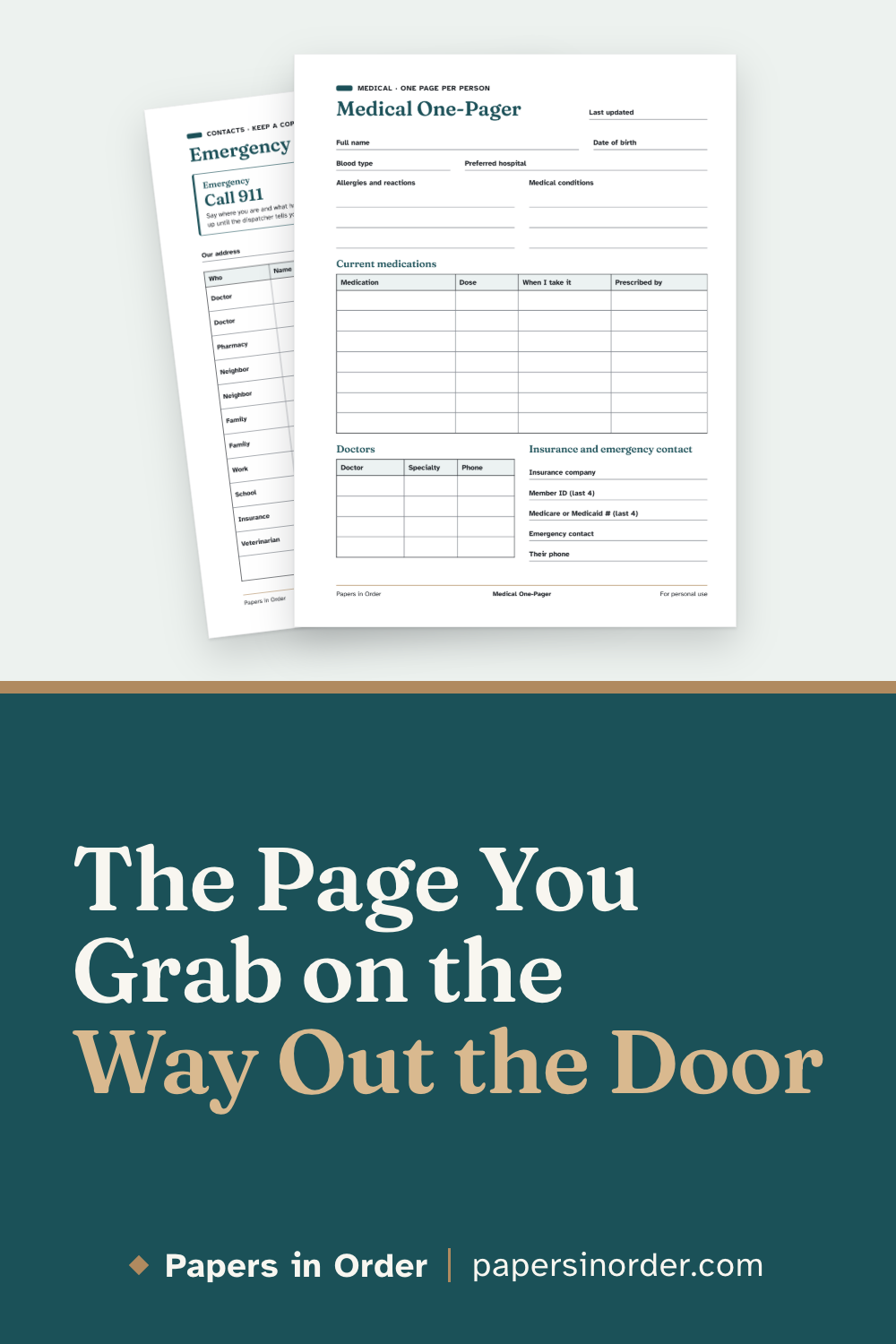
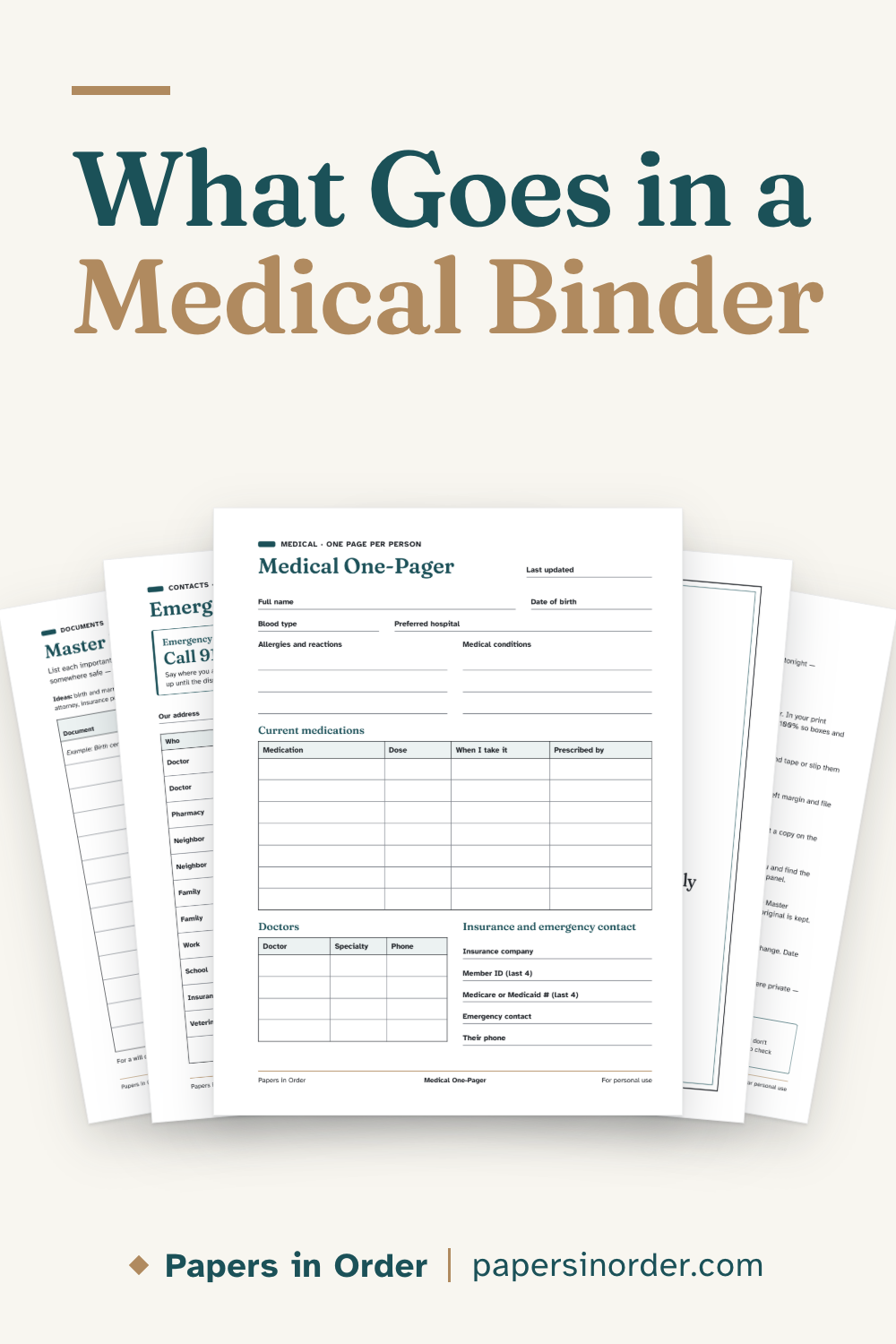
Our free Home Binder Starter is ten printable pages, US Letter, made to fill in with a pen. One of the ten is the Medical One-Pager — name, date of birth, blood type, preferred hospital, allergies, conditions, current medications with dose and prescriber, doctors and insurance — and another is an Emergency Contacts page for the fridge door. Print one Medical One-Pager per person and you have the core of a medical binder tonight.
To be straight about the file: the medication list, appointment log and records-requested page above are not among the free ten. Those you rule yourself, and a lined page in the same binder does the job.
If you keep this binder while helping a parent, our caregiver checklist for daily, weekly and monthly tasks covers the routine around it. For the paper side of the same job, see important documents organization.
Sources: the Office of the National Coordinator for Health Information Technology (HHS) guide "Get It, Check It, Use It" at healthit.gov; Medicare.gov, from the Centers for Medicare & Medicaid Services, on your Medicare card; MedlinePlus, from the National Library of Medicine, on personal health records at medlineplus.gov; and Ready.gov, from FEMA, on preparing older adults. Checked September 2026. An organizing guide, not medical advice.