Caregiving
Emergency Medical Information Sheet: What to Put on the Fridge for Paramedics
An emergency medical information sheet is a single page that speaks for someone when they can't. If your father collapses in the kitchen, or your mother is confused after a fall, the paramedics who come through the door need a few facts fast: what conditions she has, what she takes, what she is allergic to, and who to call. A page on the fridge answers all of that before anyone has to ask.
This post covers what to write on the sheet, why the refrigerator became the standard place for it, the free programs some fire departments run, and the wallet card that goes with it. It is an organizing guide, not medical advice. In an emergency, call 911 first.
Why the fridge
It sounds odd until you hear the reasoning. The Alameda County Fire Department in California, which runs a Vial of Life program, explains it plainly: "As nearly all homes have a refrigerator that can be easily located, the top shelf of the refrigerator has been adopted as the standard vial storage location."
Fire departments in many towns run programs like this. The City of Corona, California describes how its works: a personal information sheet "is completed and stored inside a prescription medication type Vial which is then placed inside your refrigerator for safe storage. A special Magnet is placed on the refrigerator door to alert Firefighters, Paramedics and Police Officers to locate your 'Vial of Life.'"
Alameda County adds the purpose in one line: "The Vial of Life Program is designed to speak for you when you are unable to speak for yourself."
Some are free; Corona says its program "is provided free of charge to residents in the community." Call your local fire department's non-emergency number, or your Area Agency on Aging, and ask whether one exists where your parent lives. Programs, kits and names differ from town to town. If there isn't one, a clearly written page taped inside the fridge door, or on its front, does the same job.
What to write on the sheet
Alameda County lists what the information inside the vial should cover: "the patient's current medical history, allergies and medications, as well as insurance information and who to contact in the event of an emergency." In practice, one sheet per person, in large clear print:
- Full name and address
- Health conditions, such as heart failure, diabetes, a pacemaker, dementia
- Allergies, especially to medicines, in large letters near the top
- Where the medicine list is (or the list itself, if it fits)
- The main doctor and phone number
- Two people to call, with phone numbers
- The insurance plan, with only the last 4 digits of the member ID
- Where the advance directive is kept, if there is one
- The date you last updated it
Alameda County also advises that while filling it in, "it is very important to print all information as clearly as possible and to consult with your Doctor if you are unable to answer specific medical questions." If there is more than one person in the house, it suggests a separate vial for each, with the person's name on the outside.
Never put a full Social Security number, a full Medicare number or any password on a sheet that sits on a refrigerator.
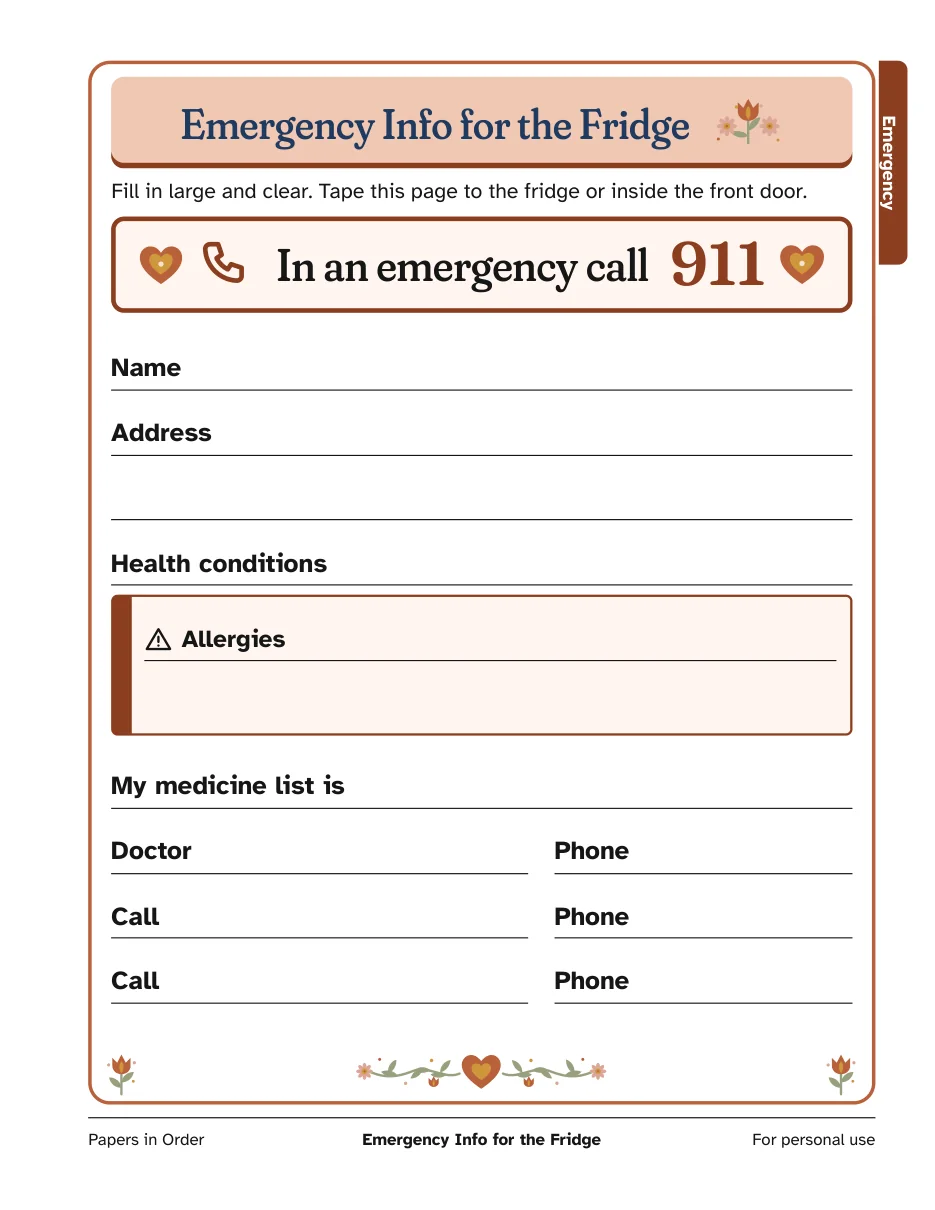
A real page from the Family Medical Binder
This is the Emergency Info for the Fridge page from our Family Medical Binder. Print it and fill it in by hand, or type into it on a computer.
Large and clear, for the fridge door or inside the front door.
See all 32 pagesKeep the medicine list current
The sheet is only as good as its medicine list. Copy names and strengths from the pharmacy labels, not from memory, and include vitamins, eye drops, inhalers and anything bought without a prescription. When a doctor changes a dose, cross out the old line and write the new one with the date. An old list can mislead, because it looks reliable. Our Family Medical Binder keeps a separate Medicine Changes page for exactly this.
Our medication list printable article goes through the columns in detail.
The advance directive and a DNR
If your parent has an advance directive, the sheet should say where it is. The National Institute on Aging suggests you "give copies to your health care proxy, health care providers, and lawyer," and notes that "some people also choose to carry a card in their wallet indicating they have an advance directive and where it is kept."
Some people also have an out-of-hospital DNR order, which, as the NIA explains, "alerts emergency medical personnel to your wishes regarding measures to restore your heartbeat or breathing if you are not in a hospital." These orders are set up with a doctor, and the forms and rules differ by state. For the related POLST or MOLST forms, the NIA suggests checking with your state department of health. If your parent has one, ask the doctor where it should be kept at home so responders can find it, and note that place on the sheet.
The wallet card that goes with it
The fridge sheet only helps at home. For everywhere else, a small card in the wallet carries the most important lines: name, date of birth, allergies, conditions, the doctor, and one person to call. Make two: one for your parent's wallet and one for yours. Our Family Medical Binder has a Wallet Emergency Card, two to a page, to cut out.
Ready.gov's guidance for emergency communication suggests saving an emergency contact in the phone too, under "ICE" (In Case of Emergency). Our post on the emergency contact list covers that, and what to put on a contacts page by the phone.
Once a year, and after any hospital stay
Put a date on the sheet and look at it on the same day each year: a birthday works well. Update it the same day after any hospital stay or new diagnosis. Then tell the family, the neighbor with a key and any home aide that it is there.
If a trip to the ER does happen, the same page goes with you. Our guide on what to bring to the ER covers the rest of that list.
Our printable for this
Our Family Medical Binder is a 32-page printable, $8.99, in large print, and it opens with exactly these pages. Emergency Info for the Fridge says "Fill in large and clear. Tape this page to the fridge or inside the front door," with "In an emergency call 911" printed at the top and lines for name, address, health conditions, allergies, where the medicine list is, the doctor, and two people to call. The Medical One-Pager holds the fuller version for one person: date of birth, blood type, allergies, conditions, doctor and pharmacy, the insurance plan with only the last 4 digits of the member ID, two emergency contacts and where the advance directive is kept. The Wallet Emergency Card prints two fold-over cards, one for the wallet and one for a family member. Then come the medicines pages, doctors and insurance, records and the hospital section. See inside the Family Medical Binder.
Our $19 Home Binder Family Kit includes three Medical One-Pagers (one per person) and a Medication List in its Medical section, plus emergency contacts and the Grab First pages. The free Home Binder Starter has one Medical One-Pager and an Emergency Contacts page, enough for one parent's fridge tonight.
Print the Family Medical Binder and fill in the fridge page
Sources: Alameda County Fire Department, "Vial of Life"; City of Corona Fire Department (California), "Vial of Life & QR Code"; the National Institute on Aging (NIH), "Advance Care Planning: Advance Directives for Health Care"; Ready.gov / FEMA, "Family Emergency Communication Planning." Checked November 2026. Local programs and state rules vary. An organizing guide, not medical advice. In an emergency, call 911.