Caregiving
What to Bring to the ER With an Aging Parent (and the One Page That Speeds It Up)
The call usually comes at an inconvenient hour. Mom fell, or Dad is short of breath, and a neighbor or an ambulance crew is already on the way. You meet them at the emergency room, and within the first ten minutes someone at the desk asks a run of questions you half know. Date of birth. Allergies. What medicines, at what dose. Who her doctor is. Whether she has an advance directive, and who can speak for her.
You can answer most of that from memory on a good day. At two in the morning, with a parent in pain, it helps to have it on one page. This post covers what to bring, the page that does most of the work, and what to write down once the ER visit turns into a hospital stay.
If anyone is in danger, call 911 first. This is an organizing guide, not medical advice: every decision about care belongs to the doctors and nurses treating your parent. The binder only records what they decide.
The questions you will be asked first
Whether your parent arrives by ambulance or by car, the same facts come up early. They fall into five groups:
- Who they are: full name, date of birth, address, the emergency contact
- What they have: health conditions, past surgeries, and anything that would change how they are treated
- What they react to: drug allergies and other reactions, and what happens
- What they take: every medicine, with the strength and when it is taken, including vitamins, eye drops, inhalers and anything bought without a prescription
- Who decides: whether there is an advance directive, where it is, and who the health care proxy is
If your parent is confused, in pain or sedated, you may be the only source for all five. A single sheet with those answers, current and dated, is worth more than a folder of records nobody has time to read.
The one page: a medical information sheet
Call it a medical one-pager or an emergency information sheet. One page per person, in a sheet protector, with:
- Full name, date of birth and blood type if known
- Allergies, in large letters near the top
- Health conditions
- The main doctor and phone, and the pharmacy and phone
- The insurance plan, with only the last 4 digits of the member ID
- Two emergency contacts with phone numbers
- Where the advance directive is kept
- A "last updated" date
Don't skip the date. A list from two years ago can be wrong in ways that matter, and the date tells the nurse how far to trust it.
Then a separate medicine list, because one line per medicine is not enough room. For each: the name and strength as printed on the bottle, the dose and how it is taken, what it is for, who prescribed it, and when it is taken. Copy it from the pharmacy labels, not from memory. The My Medicines page in our Family Medical Binder has a box for each of those. When anything changes, cross out the old line and write the new one with the date, so a doctor can see what changed recently.
Our post on medical binder printables covers how to build the full binder behind these two pages. Here, the goal is narrower: the pages that leave the house in the first five minutes.
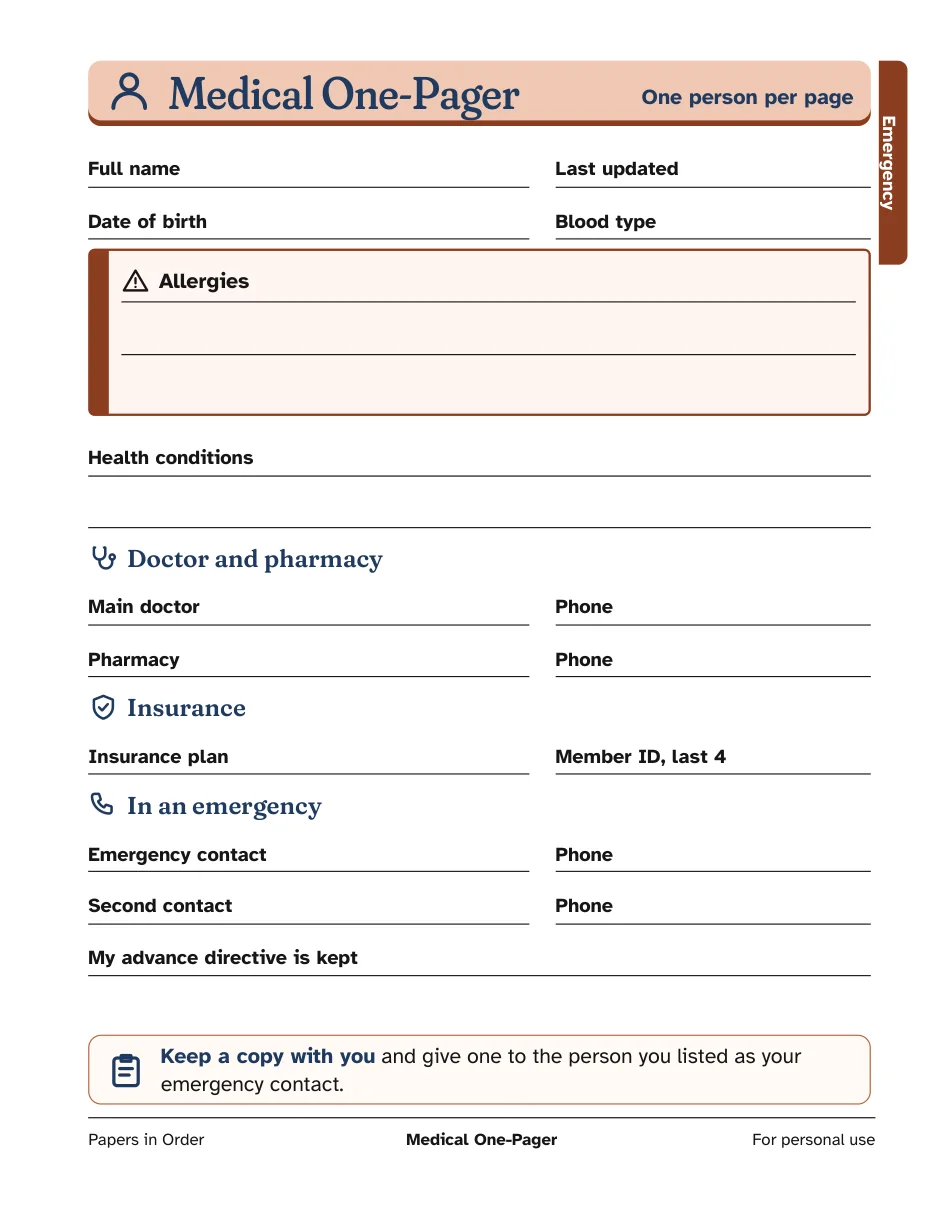
A real page from the Family Medical Binder
This is the Medical One-Pager page from our Family Medical Binder. Print it and fill it in by hand, or type into it on a computer.
One person per page: allergies, conditions, doctor, insurance, who to call.
See all 32 pagesWhat to bring: the short list
Keep this list on the inside cover of the binder, or taped inside the closet door where the hospital bag lives.
Papers
- The medical information sheet and the current medicine list
- Photo ID and insurance cards. Ready.gov's guidance for older adults says to "Make copies of Medicaid, Medicare, and other insurance cards," and the copies are what belong in the binder
- A copy of the advance directive, if there is one
- Phone numbers of family and the main doctor, on paper
Which insurance card? Medicare.gov draws a line families often miss. With Original Medicare, "Carry your Medicare card with you when you're away from home." With a Medicare Advantage Plan or other Medicare health plan, "You'll use your plan's card to get services, not your Medicare card." Bring whichever card your parent actually uses, plus a supplement or drug plan card if they have one.
Things they use every day
- Glasses and their case
- Hearing aids, the case and spare batteries. A parent who can't hear the questions can't answer them
- Dentures and their case
- A cane or walker
- A phone and a long charger cord
For you: a notebook and a pen. You will want to write down names and what each one said.
Leave at home: jewelry, large amounts of cash and anything you would hate to lose.
The advance directive and the proxy
If your parent has an advance directive or has named a health care proxy, the ER will want to know. The National Institute on Aging's advice on directives is to "Give copies to your health care proxy, health care providers, and lawyer." So a copy should already be in the doctor's file, and one should be in the binder you carry.
The NIA also says, of a proxy: "Make sure your proxy knows the names and contact information for your health care providers." If you are the proxy, the medical information sheet is that knowledge, written down. If you are not, the sheet should name who is and how to reach them.
Whether your parent needs a directive, and what it should say, is their decision, made under their state's rules. Our estate planning binder checklist explains what each document is and where the originals usually live.
If they stay: admitted or "observation"?
Many ER visits end with a parent kept overnight. It is worth asking one question then and writing the answer down: is she admitted as an inpatient, or here for observation?
For anyone on Medicare, the difference affects coverage. Medicare.gov describes inpatient hospital care as starting when "You're admitted to the hospital as an inpatient with a doctor's order." Its outpatient page lists "Emergency or observation services, which may include an overnight stay in the hospital" under Part B. So a night in a hospital bed can still be an outpatient stay.
CMS requires hospitals to give a written notice, the Medicare Outpatient Observation Notice (MOON), to Medicare patients who have been getting observation services as an outpatient for more than 24 hours. It must be given "no later than 36 hours after observation services are initiated or, if sooner, upon release," and an oral explanation must go with it. If you receive one, put it in the binder, and write down who explained it and when. Questions about what it means for costs go to the hospital or to Medicare.
While they are there, and on the way home
A hospital stay produces information faster than anyone can remember it. One page per stay keeps it in order: the hospital and room, the date, why they are there, the names of the nurses and doctors, what each one said, and your questions for the next round. Ask a sibling to take a turn writing when you are tired.
Before discharge, fill in a going-home page with the team, like the Going Home: Discharge Notes page in our Family Medical Binder: new or changed medicines, follow-up appointments, the warning signs they told you to watch for and who to call about them, equipment or supplies, and who helps at home. Then update the medicine list that same day, so the next ER visit starts from the right list.
If you share this work with siblings, our caregiver checklist has a one-page handoff for whoever covers your shift.
Our printable for this
Our Family Medical Binder is a 32-page printable, $8.99, in large, easy-to-read print. It opens with an emergency section: the Medical One-Pager, a wallet emergency card, and an emergency info page for the fridge. Then come the medicines (My Medicines, allergies and reactions, a weekly schedule, medicine changes), the doctors, insurance and appointment notes, health history and records, and a hospital section with a Hospital Bag Checklist, Hospital Stay Notes, Going Home: Discharge Notes and Who Helps at Home. See inside the Family Medical Binder.
Our $19 Home Binder Family Kit has shorter versions of the medical pages in its Medical section, plus an If I'm in the Hospital page in Grab First. The free Home Binder Starter includes one Medical One-Pager and an Emergency Contacts page, enough to make the single sheet for one parent tonight.
Print the Family Medical Binder for each parent
Sources: Medicare.gov pages on your Medicare card, inpatient hospital care and outpatient hospital services; CMS, "Medicare Outpatient Observation Notice (MOON)" fact sheet; the National Institute on Aging (NIH), "Advance Care Planning: Advance Directives for Health Care" and "Choosing A Health Care Proxy"; and Ready.gov (FEMA), "Older Adults." Checked October 2026. An organizing guide, not medical advice. In an emergency, call 911.