FROM THE FAMILY BINDER KIT
Medication List: What to Write for Each Medicine, Plus a Large-Print Daily Chart
What to write for each medicine so a doctor, a pharmacist or a paramedic can read it in a minute, and a big daily chart for a parent who takes several.
Start tonight, free: the Medical One-Pager in our free Home Binder Starter has a Current medications table. Get the starter ›
Only need the medical pages? My Medicines, a Weekly Pill Schedule and Medicine Changes are in the Family Medical Binder, 32 pages, $8.99
A medication list is the page people are most often asked for: at a new doctor, at the pharmacy counter, in an emergency room, by a sibling taking over for a weekend. Most of us carry it in our heads, which works until the day it doesn't.
A good list fits on one page per person and leaves nothing out. Below are the columns from the Medication List page in our Family Binder Kit, what to write in each, and the large-print daily chart that goes with it.
Medical · one page per person
The Medication List, column by column
At the top go Name, Date of birth, Pharmacy and Pharmacy phone, then a line for Allergies and reactions · Do not give. Then one row per medicine:
Medicine and strength
The name on the bottle and the strength, like the page's own example: Example: Lisinopril 10 mg. Brand or generic, write the one on the label.
Dose and how taken
How many and how: one tablet by mouth, two puffs, one drop in each eye.
When
Tick boxes for AM, Noon, PM, Bed and As needed. Ticks are quicker to read than "twice daily".
What it's for
In plain words. This is the column that helps most when someone else is reading.
Prescribed by
The doctor's name, so the right office gets the call when something changes.
Started
Month and year is enough. It helps a doctor connect a new symptom to a new medicine.

What counts as a medicine
More than most people think. The page prints the rule under the table: Include everything taken regularly: over-the-counter medicines, vitamins, supplements, inhalers, eye drops, creams and patches. The daily aspirin, the fish oil and the sleep aid all go on the list.
Go through the medicine cabinet, the kitchen counter and the nightstand with the page in hand. Copy from the bottles, not from memory.
FREE · 10 PRINTABLE PAGES
Get the free Home Binder Starter
Ten pages to start the binder tonight: Emergency Contacts, Household at a Glance, the Medical One-Pager, a document inventory, a bills tracker, a password log and more. Sent to your inbox.
Caring for a parent
For a parent: Medicines by the Hour
The Medication List is for doctors. A parent taking six pills a day needs something simpler on the fridge. This page is Large print, one row for each time of day.
Wake up, Breakfast, Midday, Afternoon, Dinner, Evening, Bedtime
Seven rows, each with an "at" line for the time. Leave the rows with no medicines blank.
Medicines and how many
"Amlodipine 1, Metformin 1". The name and the number of pills, nothing else.
Mon to Sun
A box for each day. The page says how to use them: Tick the box when the medicines are taken.

If you keep the list for a parent
Make the first list together, at the kitchen table, with every bottle out. Read each label aloud and let your parent say what it's for in their own words. That's the What it's for column, and it often turns up a pill nobody remembers starting.
Then keep one copy in the binder and one where the medicines are. If brothers and sisters share the caring, agree that whoever changes something writes it on the page and texts the others a photo. A list that only one person updates is out of date by spring.
Take the list to the pharmacy once a year and ask the pharmacist to look it over. Pharmacists check for medicines that shouldn't be taken together, and the list makes their job quick.
Before an appointment
- Check the date at the top. If it's older than the last change, update the page first.
- Add the new questions. The kit's Questions for the Doctor page is for those, so they don't get lost on a sticky note.
- Bring the allergies line. Every new office asks. Point to it.
- Write down any change before you leave. Dose up, dose down, a new prescription: on the page, with the date, before you're back in the car.
Keeping the list right
- Update it the day something changes. The page says it on the bottom line: Update it whenever a medicine starts, stops or changes, and write the new date at the top.
- Copy the hourly chart before you fill it in. It is printed for one week. A blank copy saves rewriting it every Sunday.
- Bring the list, not the bottles. One page is easier for the nurse than a bag. Bring the bottles only if asked.
- Keep a photo on your phone. For the pharmacy, or for the day the binder is at home and you're not.
- One list per person. Never two people on one page. In an emergency, the page has to match the person.
- Questions go to the professionals. The page puts it plainly: Questions about medicines go to your doctor or pharmacist. This page is a record, not medical advice.
Where it fits in the kit
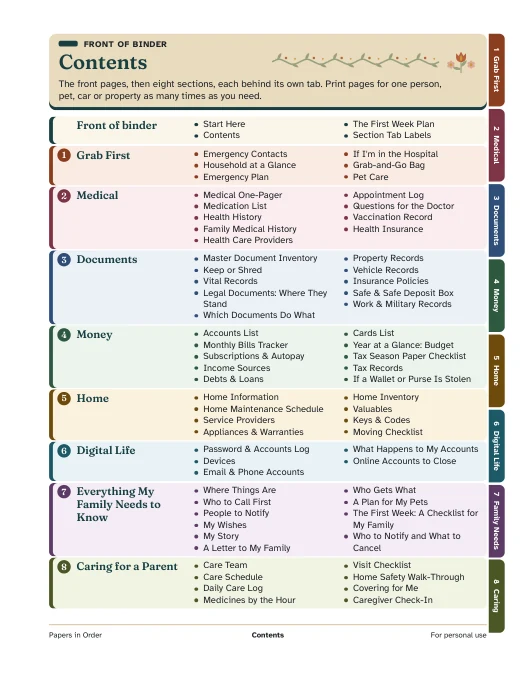
The Medication List is in the Medical section of the Family Binder Kit, with the Medical One-Pager, Health History, Health Care Providers, the Appointment Log and Questions for the Doctor. Medicines by the Hour is in the Caring for a Parent section, with the care schedule, a daily care log and the visit checklist. If you are setting up a medical binder for someone else, start with these two pages.