FROM THE FAMILY BINDER KIT
Family Medical History: What to Ask Your Relatives This Thanksgiving (and Where to Write It)
One page for the health conditions in your close family: who to ask, what goes in each column, and how to get the answers over a holiday weekend.
Start tonight, free: fill in your own allergies, conditions and medicines on the Medical One-Pager, one of the ten pages in our free Home Binder Starter. Get the starter ›
Only need the medical pages? Family Health History and Health History are in the Family Medical Binder, 32 pages, $8.99
A family medical history is a short record of the health conditions in your close family: your parents, brothers and sisters, grandparents, children, and the aunts and uncles you know about. Doctors ask for it because some conditions run in families, heart disease, diabetes and some cancers among them. Most of us can name two or three things and guess at the rest.
Thanksgiving is a good day to stop guessing. In November 2004 the U.S. Surgeon General, Richard H. Carmona, declared Thanksgiving the first annual National Family History Day, because it is the day American families traditionally gather. That is how the Department of Health and Human Services news release put it at the time (it is still published by the National Human Genome Research Institute). The relatives who know the answers are at the same table, and nobody has to make a special phone call.
Below is the grid from the Family Medical History page in our Family Binder Kit, row by row, with what to ask for each. Print the page, take it with you, and fill in what you can.
Medical · one page per person
The page, row by row
The page opens with one line of instructions, and it is the most useful thing on it: Write what you know; a blank is fine. The four columns are Relative, Health conditions, Age when diagnosed and If no longer living: age and cause.
Mother
Ask her directly if you can. Blood pressure, cholesterol, diabetes, thyroid, any cancer, and anything she takes a daily pill for.
Father
Ask about heart trouble and how old he was when it started. The age matters as much as the condition.
Sister or brother (three rows)
One row for each. Half-siblings count for the parent you share.
Mother's mother and Mother's father
Your mother or her sisters will know more than you do. Ask while you have them both in the kitchen.
Father's mother and Father's father
Often the emptiest rows. Even "heart, in his sixties" is worth writing down.
Child (two rows)
Your children's conditions belong here too, so they can copy the page one day and start with your rows.
Aunt or uncle
Use this row, and the blank one under it, for the relative everyone mentions: the aunt with breast cancer at 45, the uncle with a heart attack at 50.

How to fill it in over one holiday weekend
- Start with what you already know. Before you leave home, fill in your parents' and grandparents' rows from memory, in pencil. Then you only need to ask about the gaps.
- Ask one person at a time. Not the whole table. After the meal, on a walk, or drying dishes, people say more than they would with everyone listening.
- Ask the three questions in the columns. What was it? How old were they when it was found? And if they are no longer living, how old were they and what was the cause?
- Write "not sure" rather than guess. A question mark tells your doctor the answer is a guess. A confident wrong answer is worse than a blank.
- Make a copy for your brothers and sisters. The parents' and grandparents' rows are the same for all of you. One person can do the asking for everyone.
Questions that get real answers
General questions get general answers. "Was anyone sick?" usually gets a shrug. Specific ones work better:
Did Grandpa have heart trouble before he retired, or after? Was Grandma's cancer in her breast, or somewhere else? Does anyone on Dad's side have diabetes? What did Aunt Ruth's doctor call it? How old was Mom when she started the blood pressure pill?
If a question touches a loss that still hurts, let it go. You can ask someone else, or come back to it at Christmas.
FREE · 10 PRINTABLE PAGES
Get the free Home Binder Starter
Ten pages to start the binder tonight: Emergency Contacts, Household at a Glance, the Medical One-Pager, a document inventory, a bills tracker, a password log and more. Sent to your inbox.
Medical · one page per person
Then your own Health History
Your relatives' rows tell a doctor what might be coming. Your own history tells them what has already happened. The kit's Health History page has four tables, one for each kind of record:
Conditions and diagnoses
Columns for Condition, Since (year), Doctor treating it and Notes.
Surgeries and procedures
Including the small ones: a colonoscopy, a mole removed, a knee scope.
Hospital stays
Why, when, where. Useful the next time a form asks.
Allergies, implants and devices
The column Reaction, or details (model, date put in) is where a pacemaker model or a hip implant date goes.

Keeping it useful
- Bring it to appointments. The page itself says so, at the bottom: Bring this page to appointments. A new doctor's intake form takes two minutes with it in hand.
- Update it after each holiday. When a relative gets a new diagnosis, add it in pen and change the date in the corner.
- Write ages, not years, when you can. "Diagnosed at 52" helps a doctor more than "around 1990".
- Keep it private. Health details about your relatives are theirs too. Keep the page in your binder at home, and share it only with your own doctors.
Where it fits in the kit
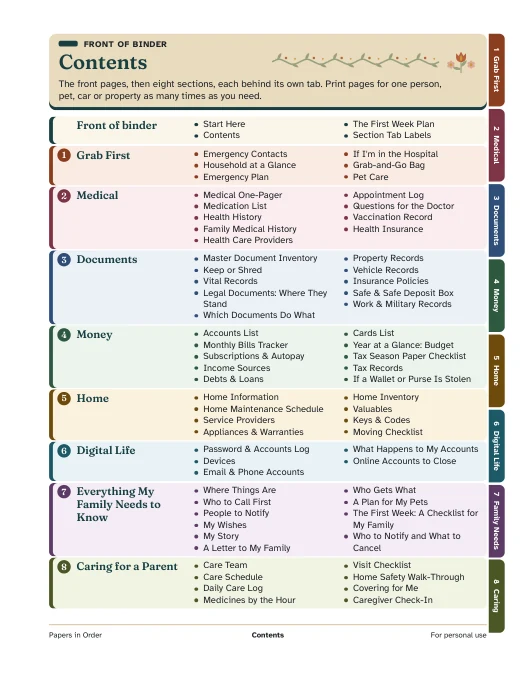
Family Medical History is one page of the Medical section of the Family Binder Kit, next to the Medical One-Pager, Medication List, Health History, Health Care Providers, Appointment Log, Questions for the Doctor, Vaccination Record and Health Insurance pages. Print one for each person in the house.
If you are putting together a medical binder for a parent, this page is the one that is hardest to fill in later. This is a page for organizing what you know. It is not medical advice: what a family history means for you is a question for your doctor.