Papers
Executor of Estate Duties: What the Job Really Involves, From First Call to Final Receipt
Executor of estate duties usually land on someone with a single sentence in a will, or a phone call from a lawyer, and then a long silence while you wonder what the job actually is. The short answer is that it is mostly careful paperwork, done over months, not days. You don't need to be a lawyer or an accountant. You do need to keep track of things.
This post explains what the job involves, step by step, using what the IRS and state courts say. It is an organizing guide, not legal, tax or financial advice. Probate rules vary by state, and the probate court clerk or an attorney is the right person to ask about yours.
Executor, administrator, personal representative
You will hear three names for the same role. IRS Publication 559 explains them: "A personal representative of an estate is an executor, administrator, or anyone who is in charge of the decedent's property." An executor is generally named in the will. An administrator "is usually appointed by the court if no will exists, if no executor was named in the will, or if the named executor can't or won't serve." And, the IRS adds, "In general, an executor and an administrator perform the same duties and have the same responsibilities."
Being named in a will is usually the start, not the authority itself. When an estate goes through probate, a court appoints the person in charge. California's court self-help guide describes it this way: to open probate, "you go to court and ask a judge to appoint a personal representative."
The three main duties
The IRS sums the whole job up in one sentence: "The primary duties of a personal representative are to collect all the decedent's assets, pay the decedent's creditors, and distribute the remaining assets to the heirs or other beneficiaries."
State courts say much the same. Utah's court self-help page lists the duties of a personal representative as contacting heirs and creditors, "collecting and taking inventory of the estate, determining and paying taxes," selling property to pay taxes or debts, and "distributing remaining proceeds to the heirs."
Everything else is detail under those three headings. Here they are in the order they usually happen.
1. Find the will and get appointed
The first practical step is the original will. California's guide says, "If you find an original will, you must deliver it to the court," and calls this "lodging the will." Other states have their own steps and deadlines. Our post on where the will is covers where originals usually turn up.
Then ask the probate court clerk, or an attorney, whether this estate needs probate at all. Many states have a simpler process for smaller estates, sometimes using a small estate affidavit. Utah, for example, allows one in some cases when the whole estate is under $100,000, there is no real estate, and at least 30 days have passed since the death. Limits and steps differ from state to state.
Keep every court paper that names you as executor. Banks, the post office and others will ask for proof. The USPS, for example, needs "documented proof that you are the appointed executor or administrator" before it will forward a person's mail, and says "Simply having their death certificate is not enough."
2. Collect and list what they owned
This is the inventory, and it is the longest part of the job. Go through recent bank and card statements, the mail, the last tax return and the filing cabinet, and make one list of:
- Bank and investment accounts, with only the last 4 digits of each number
- The home, vehicles and valuables
- Life insurance, pensions and retirement accounts
- Digital accounts
- Money owed to them, such as a final paycheck or a refund
For each account, ask the bank whether it has a joint owner or a "payable on death" or "transfer on death" beneficiary. Those accounts may pass outside the will, and the bank will tell you what it needs from you.
The IRS says the first thing a personal representative should do for tax purposes is "apply for an EIN for the estate," an identification number for the estate itself, which you can get free online at IRS.gov/EIN. You will need it to open an estate bank account and file the estate's returns. The IRS also asks you to file Form 56, which "notifies the IRS that you, as the fiduciary, are assuming the powers, rights, duties, and privileges of the decedent."
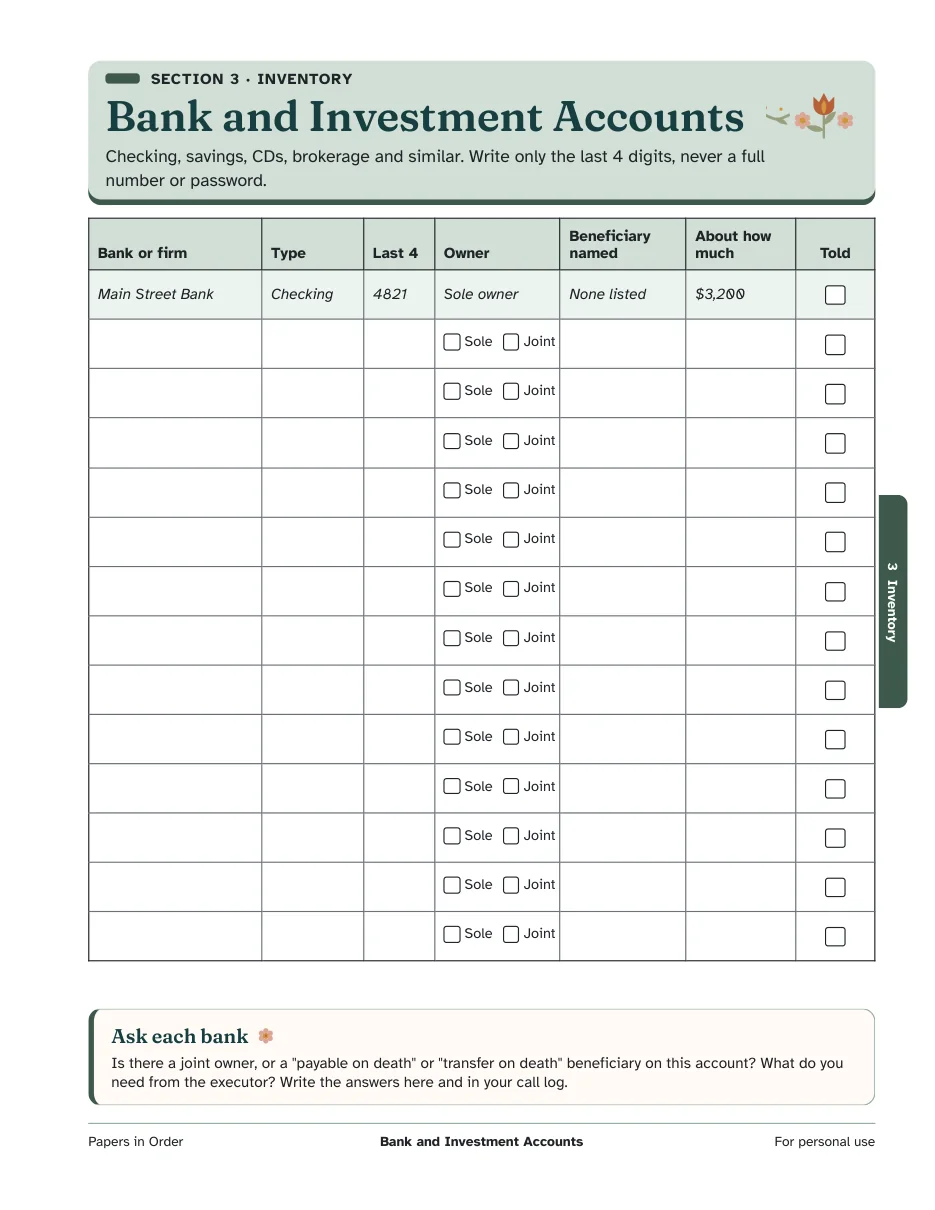
A real page from the Executor's Checklist
This is the Bank and Investment Accounts page from our Executor's Checklist. Print it and fill it in by hand, or type into it on a computer.
Last 4 digits only, with the owner and the named beneficiary.
See all 33 pages3. Pay what is owed, in the right order
This is the step to take slowly. The CFPB explains that "When someone dies, their debts are generally paid out of the money or property left in the estate." Family members are not usually responsible from their own money. The exceptions are specific: a co-signer, a joint holder on a credit card (not just an authorized user), and some surviving spouses under state law, including in community property states.
The CFPB is also clear that "it's illegal for debt collectors to suggest you're responsible for paying from your own money."
As executor, list every debt and bill before paying any of them. The Debts and Bills page in our Executor's Checklist is set up for that list. Don't pay the estate's bills from your own pocket. Ask the attorney or the clerk which bills to keep paying to protect the property, such as the mortgage, home insurance and utilities, and in what order creditors are paid in your state. The IRS warns that an executor who pays others before the estate's federal taxes can be personally responsible for those taxes, and state law can add other cases, so ask first.
The tax returns
There may be two:
- The person's final income tax return (Form 1040) for the year they died. The IRS says to prepare it "the same way you would if the person were alive," with income up to the date of death. If a refund is due, Form 1310 is often needed to claim it.
- The estate's own return (Form 1041). The IRS says every estate with gross income of $600 or more in a tax year must file one. A tax professional can tell you whether this estate needs one.
If you are paid a fee for serving, the IRS says "All personal representatives must include fees paid to them from an estate in their gross income."
4. Hand out what is left, and close the estate
Only after the debts, taxes and expenses are settled does the estate go to the heirs. Write down who received what, on what date, and get a signed receipt for each distribution. Some courts and some heirs may want a final account of every dollar in and out of the estate.
Then the last steps: tell the court the estate is finished if probate was opened, close the estate bank account, stop the mail forwarding, and keep the records somewhere safe. Ask the tax preparer how long to keep them.
What helps most: one place for everything
The habit that helps most is simple. Put everything in one binder. Write down every call with the date, the person and any reference number, so you never have to call twice. Our Executor's Checklist has a Calls and Meetings Log and an Estate Expense Log for that. Keep every receipt, and ask the attorney whether the estate can repay you for funeral and estate costs you covered yourself.
Our post on what to do when someone dies covers the first days and weeks in detail, before most executor work begins. If you are planning ahead for your own family, an estate planning binder makes the executor's search far shorter.
Our printable for this
Our Executor's Checklist is a 33-page printable, $11.99, built around these four stages. It opens with Key Facts at a Glance (the court, the case number, the attorney, where the papers are). First Days covers The First 48 Hours, The First Week and Death Certificates. Notify has Before You Call, Phone Scripts and pages for government, banks, home and everyday accounts. Inventory has Bank and Investment Accounts, Home, Vehicles and Valuables, Insurance and Retirement, Digital Accounts, Debts and Bills, and Payments to Stop. Paperwork & Money has Taxes and Key Dates, Probate Basics (with the questions for the clerk), an Estate Expense Log, a Mail and Letters Log and a Calls and Meetings Log. It ends with Distributions, with a signed-receipt column, and a Closing Checklist. See inside the Executor's Checklist.
If you are getting ready for your own family rather than serving as executor, our $19 Home Binder Family Kit is the other half: the documents, accounts and wishes an executor will look for first, all in one binder. To start for free, the free Home Binder Starter has a Master Document Inventory page.
Print the Executor's Checklist and start with Key Facts
Sources: IRS Publication 559, "Survivors, Executors, and Administrators"; IRS, "File the final income tax returns of a deceased person"; CFPB, "Does a person's debt go away when they die?"; USPS, "Mail for the deceased"; Judicial Branch of California, "Guide to property after someone dies"; Utah State Courts, "Informal Probate." Checked November 2026. Rules vary by state; when in doubt ask the probate court clerk or an attorney. An organizing guide, not legal, tax or financial advice.