Caregiving
Questions to Ask the Doctor: A One-Page List for an Aging Parent's Next Appointment
Questions to ask the doctor are easy to think of in the car on the way home and surprisingly hard to remember in the exam room. The appointment is short, the doctor is kind but busy, and your mother answers "fine" to every question. Twenty minutes later you are in the parking lot with half of what you came to ask still unasked.
The fix is old-fashioned: write the questions down the day before, bring the page, and write the answers next to them. This post gives you the questions, grouped the way the National Institute on Aging groups them, plus what to bring and how to help a parent at the visit without taking it over. It is an organizing guide, not medical advice. Every question about health, treatment or medicines goes to the doctor, nurse or pharmacist.
Start with a short list, most important first
The NIA's advice for preparing for an appointment is to "make a list of what you want to discuss," and if there are more than a few items, to "put them in order and ask about the most important ones first." It adds that the things really on your mind should not wait for the end of the appointment: "bring them up right away!"
Three or four real questions are better than twelve. Our Family Medical Binder has a Questions for the Doctor page to write them on before the visit. Before the visit, sit down with your parent and ask: What is bothering you most? What has changed since the last visit? Is anything about the medicines worrying you?
NIA also suggests telling the doctor what has happened since the last visit: an ER trip, a new specialist, and "any changes you have noticed in your appetite, weight, sleep, or energy level," plus any recent changes in medicines and how they have felt.
The questions, by topic
Pick the ones that fit this visit. You won't need all of them.
About a new symptom or problem
- What do you think is causing this?
- Is it something to worry about, or something to watch?
- What should we do if it gets worse, and who do we call after hours?
About a test
The NIA lists these questions to ask before a medical test:
- "Why is the test being done?"
- "What steps does the test involve?"
- "How should I get ready?"
- "Are there any dangers or side effects?"
- "How will I find out the results?"
- "How long will it take to get the results?"
- "What will we know after the test?"
It also suggests asking for a written copy of the results, and if a specialist does the test, asking "to have the results sent to your primary doctor."
About a diagnosis
- "What may have caused this condition?"
- "Will it be permanent?"
- "How is this condition treated or managed?"
- "What will be the long-term effects on my life?"
- "How can I learn more about my condition?"
About a medicine
The NIA suggests asking the doctor "to write down how often and for how long you should take it," and making sure the doctor knows every other medicine your parent takes, "so he or she can prevent harmful drug interactions." Useful questions:
- What is this medicine for, and what is it called?
- How and when should it be taken, and for how long?
- What side effects should we watch for?
- Does it replace anything she already takes?
And the one many people feel shy about: cost. NIA says "Don't hesitate to ask the doctor about the cost of your medications," and offers a sentence you can use word for word: "It turns out that this medicine is too expensive for me. Is there another one or a generic drug that would cost less?"
At a yearly wellness visit
If your parent has Medicare Part B and is eligible, the yearly "Wellness" visit is covered "once every 12 months." Medicare.gov adds a useful line for any visit: "Ask your doctor or healthcare provider how much your test, item, or service will cost." That is a fair question to write on the list.
What to bring
The NIA's caregiver guidance suggests you bring:
- The person's insurance cards
- "Names and phone numbers of other doctors they see"
- Their medical records, if this doctor doesn't have them
- "A list with the names, dosage, and schedule of all medicines, vitamins, herbal remedies, over-the-counter drugs, and dietary supplements the older adult is taking"
- Glasses, and a hearing aid that is working and worn
That last point matters more than it sounds. NIA suggests telling the doctor and staff if your parent has a hard time seeing or hearing, and even offers a line: "My hearing makes it hard to understand everything you're saying. It helps a lot when you speak slowly and face me when you're talking."
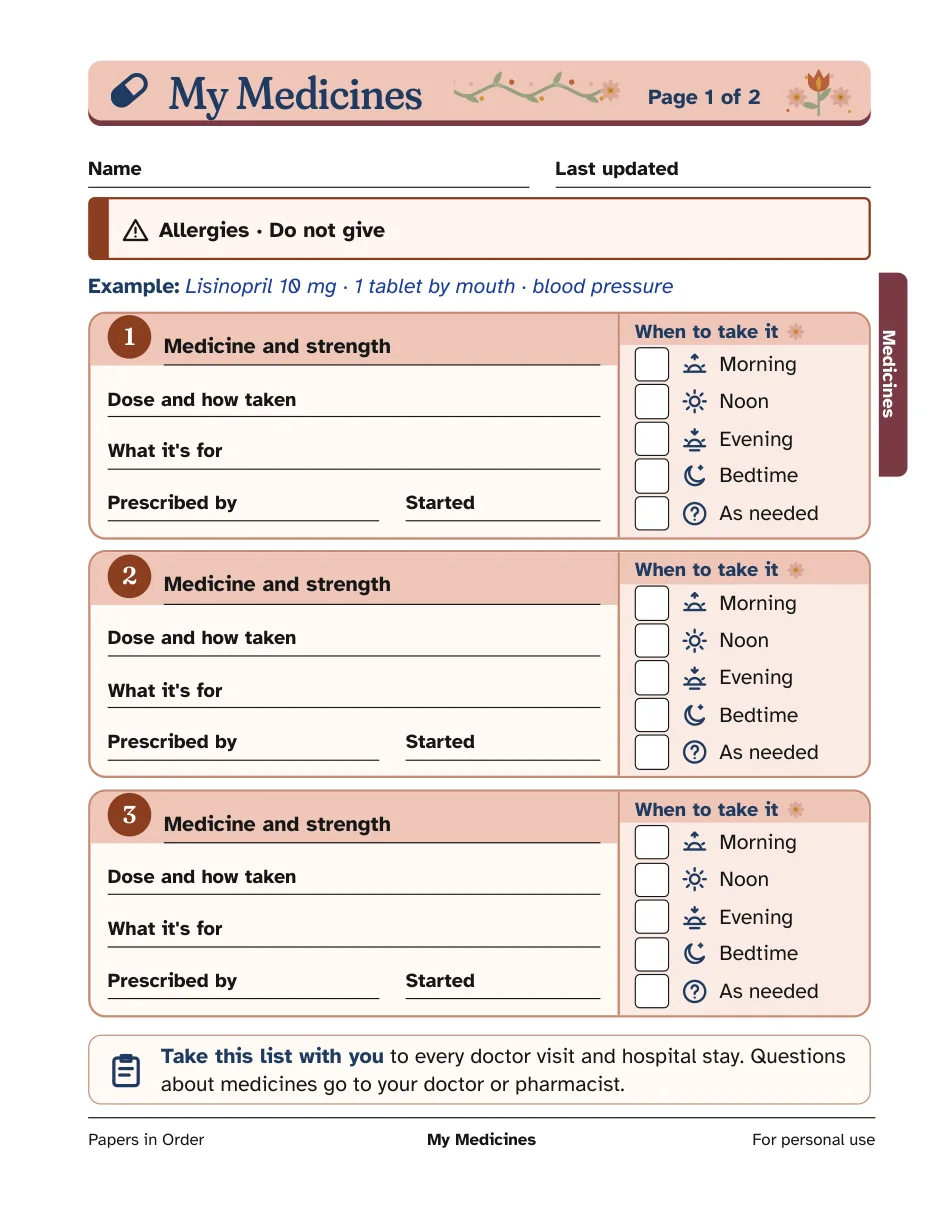
A real page from the Family Medical Binder
This is the My Medicines page from our Family Medical Binder. Print it and fill it in by hand, or type into it on a computer.
Dose, what it's for, who prescribed it and when to take it.
See all 32 pagesHelping without taking over
If you go along, you are the note-taker, not the patient. The NIA's caregiver guidance is direct: "When the doctor asks a question, let the older adult answer unless you have been asked to do so," and "Always include the person you care for when you talk with the doctor." Leave the room if your parent asks; they may want to raise something privately.
One practical point before the visit: the doctor may not be able to share information with you unless your parent agrees. NIA explains that a parent can tell the doctor out loud that they agree to have you there, and that most offices have a consent form, "sometimes called a HIPAA release," to name who can have access to their medical information. Ask about it at the front desk.
Before you leave the room
Read back what you wrote, and check you have the answers to these:
- What did the doctor say, in plain words?
- What changes to the medicines, if any?
- What are the next steps: tests, referrals, a follow-up?
- When is the next visit?
Then update the medicine list that same day. The Appointment Notes page in our Family Medical Binder has room for what was decided. If you share caregiving with siblings, our caregiver checklist has a simple way to pass the notes along. For what to bring if a visit ever turns into a trip to the hospital, see what to bring to the ER.
Our printable for this
Our Family Medical Binder is a 32-page printable, $8.99, in large, easy-to-read print. Its Doctors & Insurance section has Questions for the Doctor (doctor, date of visit, six numbered questions, each with a line for the answer, and "It's fine to ask the doctor to slow down, or to write something down for you" printed at the foot) and Appointment Notes (Why I went, What the doctor said, Changes to my medicines, Next steps, Next visit), plus Doctors & Pharmacy and Health Insurance. The Medicines section has My Medicines, Allergies & Reactions, a Weekly Pill Schedule and Medicine Changes, so the list you bring is always current. See inside the Family Medical Binder.
Our $19 Home Binder Family Kit has its own Questions for the Doctor page, with room for what you've noticed, when it started and how often, plus an Appointment Log and a Medication List in its Medical section. The free Home Binder Starter includes a Medical One-Pager, a good first page to bring to any appointment.
Print the Family Medical Binder before the next appointment
Sources: the National Institute on Aging (NIH), "How To Prepare for a Doctor's Appointment," "What Should I Ask My Doctor During a Checkup?" and "Taking Someone to a Doctor's Appointment: Tips for Caregivers"; Medicare.gov, "Yearly 'Wellness' visits." Checked November 2026. An organizing guide, not medical advice.